Best Analog Clocks for ADHD Time Awareness: Conquer Time Blindness
Do you ever feel like time just disappears? One minute you’re starting a task, the next you look up and hours have…

Do you ever feel like time just disappears? One minute you’re starting a task, the next you look up and hours have vanished, leaving you scrambling or missing deadlines. This common experience, often called “time blindness.” It’s a significant challenge that makes it tough to estimate how long tasks will take, transition between activities, or even remember appointments.
At Vidalit, we understand that productivity is about working smarter with your ADHD brain, not against it. The individuals with ADHD process temporal information differently, struggling with what neuroscientists call “time perception deficits.” It’s like seeing individual frames of a movie instead of the continuous action.
That’s where analog clocks come in as powerful productivity tools. In this article, we’ll explore some of the best analog clocks and visual timers that are specifically designed to support ADHD brains in perceiving and managing time more effectively. Get ready to transform your relationship with time and boost your productivity, the Vidalit way!
What to Look For in Analog Clocks for ADHD Time Awareness
Choosing the right analog clock for ADHD time awareness is about finding a tool that actively helps your brain understand and manage the flow of your day. Here’s what to prioritize:
Visual Clarity and Simplicity
For an ADHD brain, clutter and complexity can be immediate distractions. Look for clocks with clear, large numbers or distinct markers that are easy to read at a glance. A simple face without too many ornate details helps you quickly grasp the time without getting overwhelmed. The goal is instant comprehension, not aesthetic intricacy.
Silent Operation
A ticking clock can be a major sensory distraction for many with ADHD, pulling focus away from tasks and increasing anxiety. Opt for clocks with a silent sweep second hand or those specifically advertised as non-ticking. This ensures a peaceful environment conducive to focus and reduces unnecessary auditory input. A quiet clock can make a big difference in maintaining concentration.
Visual Countdown or Timer Functionality
One of the most effective features for ADHD time awareness is a visual timer that shows time decreasing. Clocks with a colored disk that disappears as time passes, like the Time Timer, make the abstract concept of “time remaining” concrete. This visual cue helps you gauge how much time is left for a task, encouraging better pacing and reducing last-minute rushes.
Durability and Ease of Use
You want a tool that can withstand daily use and doesn’t require complex setup. Clocks that are robust and straightforward to operate will be more likely to become a consistent part of your routine. Avoid gadgets with too many buttons or confusing settings, as these can quickly lead to abandonment. Simplicity ensures longevity in your time management strategy.
Placement Flexibility
Consider where you need the clock most. Do you need a large wall clock for your office, a desk clock for focused work, or a portable timer for moving between rooms? Some clocks offer multiple placement options, such as a stand for a desk and a hole for wall mounting. Having clocks strategically placed wherever you frequently lose track of time is key.
Intuitive Alarms and Alerts
While visual cues are primary, an audible alarm can provide a helpful “kick” for transitions or when time is up. Look for clocks with clear, non-jarring alarm sounds that are easy to set and reset. Some visual timers include an optional alert, giving you the choice to use sound only when absolutely necessary. Gentle, effective alerts prevent overstimulation while still serving their purpose.
7 Best Analog Clocks for ADHD Time Awareness
Here are our top picks for analog clocks and visual timers that genuinely help with ADHD time awareness, offering unique features to support your productivity journey.
1. Time Timer Plus 60 Minute
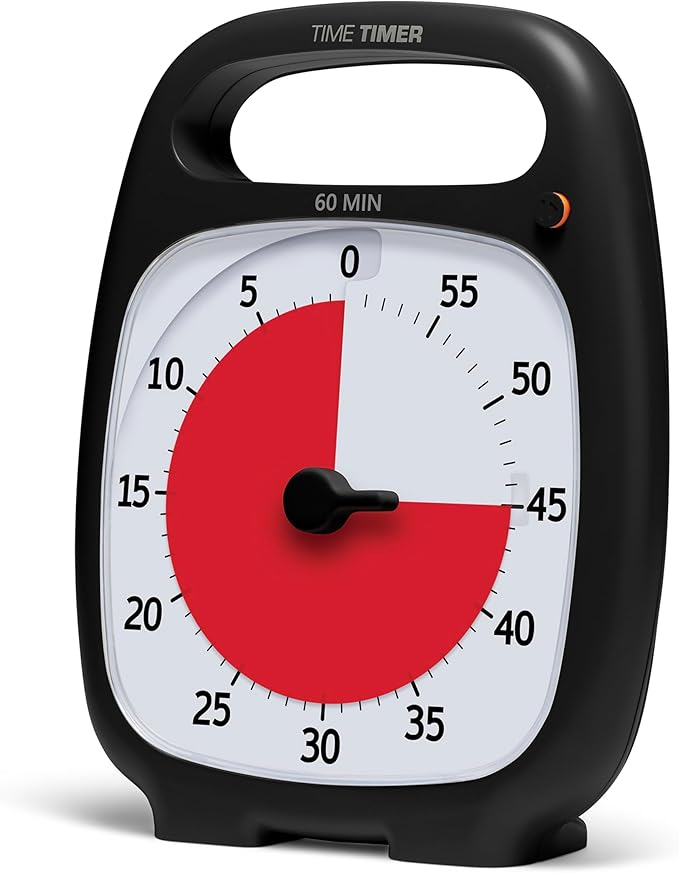
Best For: Visualizing remaining time for specific tasks.
Description
The Time Timer Plus 60 Minute is a highly recommended visual timer that uses a disappearing red disk to represent the passage of time. As minutes tick by, the red area shrinks, providing a clear, intuitive visual of how much time is left. It’s designed for durability and ease of use, making it popular for both kids and adults with ADHD.
What Makes It Great for ADHD
Concrete Time Visualization: The red disk makes abstract time tangible, helping you “see” how much time is left at a glance.
Silent Operation: It operates silently, preventing auditory distractions that can derail focus for sensitive ADHD brains.
Easy to Set: A simple dial allows for quick setting of any duration up to 60 minutes, perfect for Pomodoro techniques or focused work blocks.
Durable and Portable: Its robust construction and carrying handle make it easy to move between rooms or take to different workspaces.
Potential Drawback: Primarily a timer, not a continuous clock, so you’ll still need a separate clock for general time awareness.
👉 Best for turning “I’ll start soon” into immediate action. You literally see time running out.
2. Hippih Silent Wall Clock
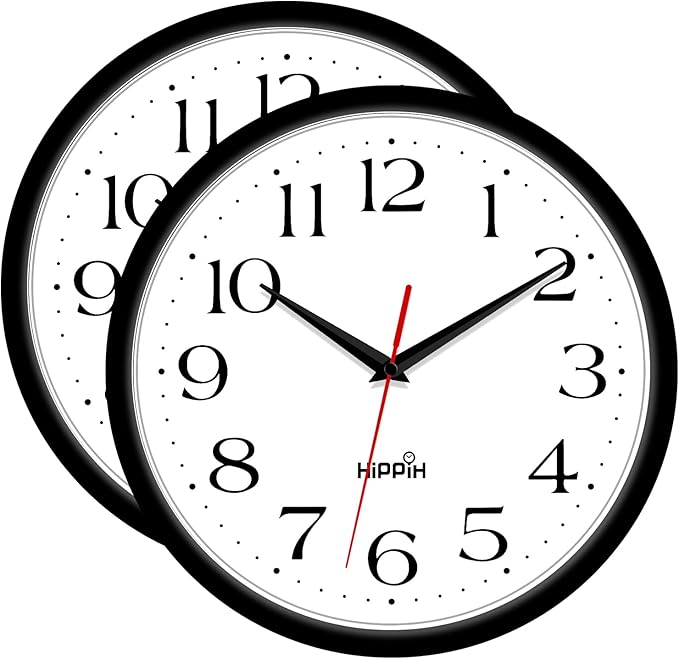
Best For: General, distraction-free time awareness in any room.
Description
The Hippih Silent Wall Clock is a classic analog wall clock designed with a non-ticking sweep second hand, ensuring a completely silent environment. It features a large, clear face with bold numbers, making it easy to read from across a room. Its simple, elegant design blends into various decors while serving a crucial function for time-blind individuals.
What Makes It Great for ADHD
Completely Silent: Eliminates the distracting ticking sound that can disrupt focus and increase anxiety for many with ADHD.
High Visibility: Large, bold numbers and clear hands allow for quick and effortless time checks, even from a distance.
Reduces Anxiety: Knowing time is passing silently without auditory reminders can help reduce the pressure and anxiety often associated with time management.
Consistent Visual Cue: Provides a steady, continuous visual of time’s progression, aiding in overall time awareness without being intrusive.
Potential Drawback: Lacks any specific timer or alarm functions, serving solely as a display for the current time.
3. Acctim Remi Analogue Alarm Clock
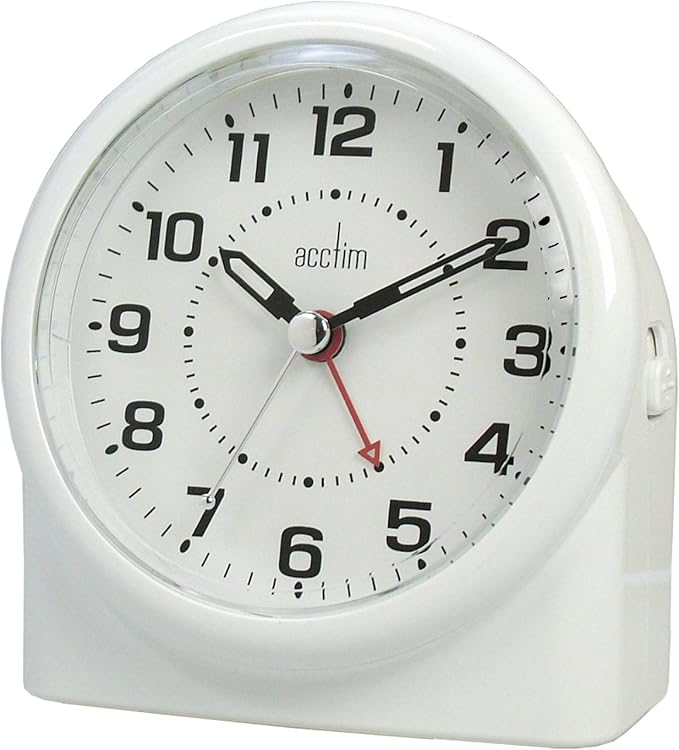
Best For: Waking up on time and gentle morning transitions.
Description:
The Acctim Remi Analogue Alarm Clock offers a classic analog experience with the added benefit of an alarm function. It’s designed to be straightforward and reliable, helping you start your day punctually. With a clear dial and easy-to-set alarm, it provides a simple, effective solution for those who struggle with waking up and getting out of bed, especially if phone alarms are too tempting to snooze endlessly.
What Makes It Great for ADHD:
Dedicated Alarm: Provides a reliable, physical alarm separate from your phone, reducing the risk of getting pulled into digital distractions first thing in the morning.
Simple Operation: Easy-to-use knobs for setting time and alarm minimize cognitive load, making it effortless to integrate into your routine.
Visual Alarm Set: The small alarm hand on the dial gives a visual cue of when the alarm is set to go off, aiding in planning your morning.
No Snooze Trap: Many analog alarms offer a simple on/off switch, helping you avoid endless snoozing that delays your day.
Potential Drawback: The alarm sound might be too jarring for some, and it may not be completely silent if it has a traditional ticking mechanism.
4. Secura 60-Minute Visual Timer
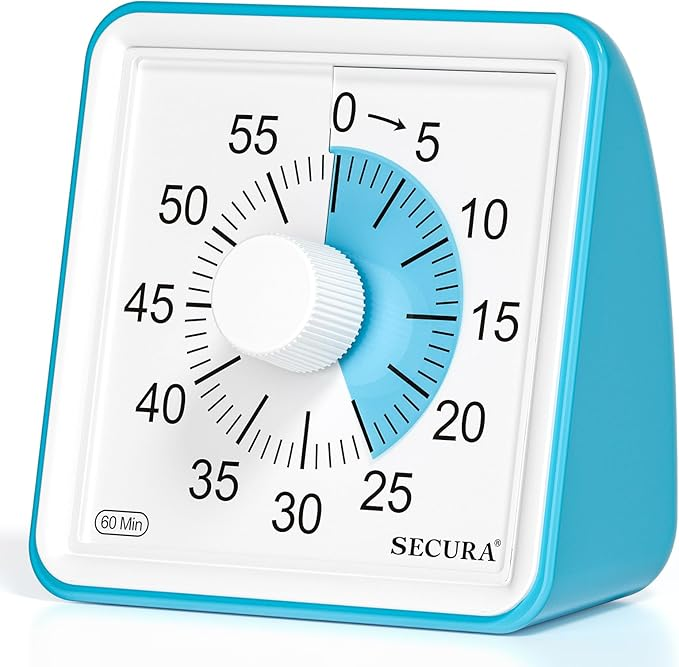
Best For: Budget-friendly visual time management for short to medium tasks.
Description: The Secura 60-Minute Visual Timer is another excellent option for those who benefit from seeing time disappear. Similar to the Time Timer, it features a red disk that gradually diminishes as time elapses, offering a clear visual countdown up to 60 minutes. It’s often more budget-friendly while still providing essential visual timing capabilities.
What Makes It Great for ADHD:
Effective Visual Countdown: The red disk provides immediate, easy-to-understand feedback on how much time remains for a task.
Affordable Option: Offers similar core functionality to higher-priced visual timers, making it accessible for more users.
Versatile Placement: Comes with a magnetic back for refrigerators or whiteboards, and a stand for desk use, allowing for flexible placement.
Optional Alarm: Includes an optional alarm at the end of the countdown, which can be turned off for silent use, catering to sensory preferences.
Potential Drawback: The build quality might not be as robust as premium alternatives, and the alarm sound may be basic.
5. Kikkerland Big Wheel Clock
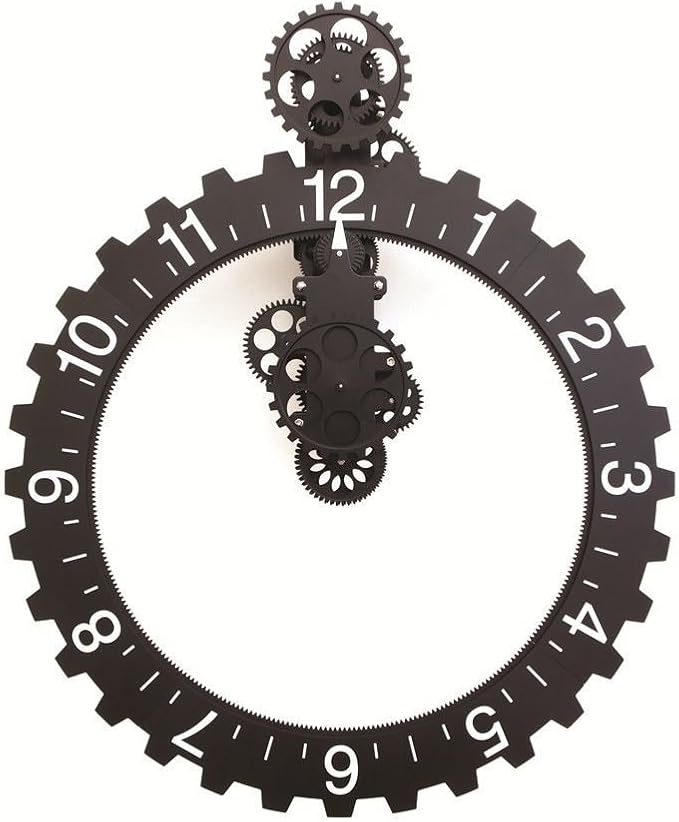
Best For: Making time highly visible in shared spaces or for significant visual impact.
Description: The Kikkerland Big Big Clock is exactly what it sounds like: a very large analog wall clock designed for maximum visibility. With its oversized numbers and hands, it ensures that time is impossible to ignore, even from a distance. Its minimalist design keeps the focus squarely on the time, making it a powerful visual aid for time awareness.
What Makes It Great for ADHD:
Unmissable Time Display: Its sheer size ensures that time is always in your field of vision, helping combat time blindness by constantly reminding you of the current hour.
Clear, Simple Design: Large, bold numbers and clear hands minimize visual clutter, making it incredibly easy for an ADHD brain to process the information quickly.
Passive Time Awareness: By simply being present and highly visible, it helps you passively track time and develop a better internal clock without active effort.
Statement Piece: Its unique size can also serve as a conversation starter about time management and productivity in your home or office.
Potential Drawback: Its large size might not fit every space or aesthetic preference, and it typically requires a fair amount of wall space.
6. School Smart Classroom Timer
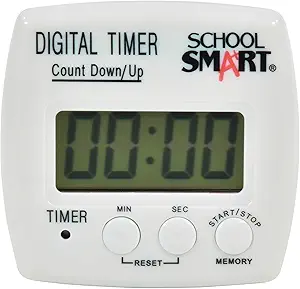
Best For: Simple, no-frills mechanical timing for short, focused bursts.
Description: The School Smart Classroom Timer is a robust, mechanical wind-up timer, often used in educational settings. It features a clear, traditional analog dial that counts down from up to 60 minutes with an audible ding when time is up. Its straightforward, tactile operation makes it a reliable tool for managing specific task durations.
What Makes It Great for ADHD:
Tactile Setting: The physical act of winding the timer can be grounding and helps solidify the commitment to a time block.
Clear Visual Progress: While not a “disappearing disk,” the moving hand on a clear dial still offers a good visual representation of time passing.
Audible Alert: The distinct “ding” at the end of the countdown provides a clear, unmistakable signal that the task time is complete, prompting transitions.
No Batteries Required: Operates mechanically, so there’s no need to worry about battery life or charging, making it a reliable, low-maintenance option.
Potential Drawback: It typically has a loud ticking sound as it counts down, which can be highly distracting for some individuals with ADHD.
7. Marathon Atomic Wall Clock with Analog Display
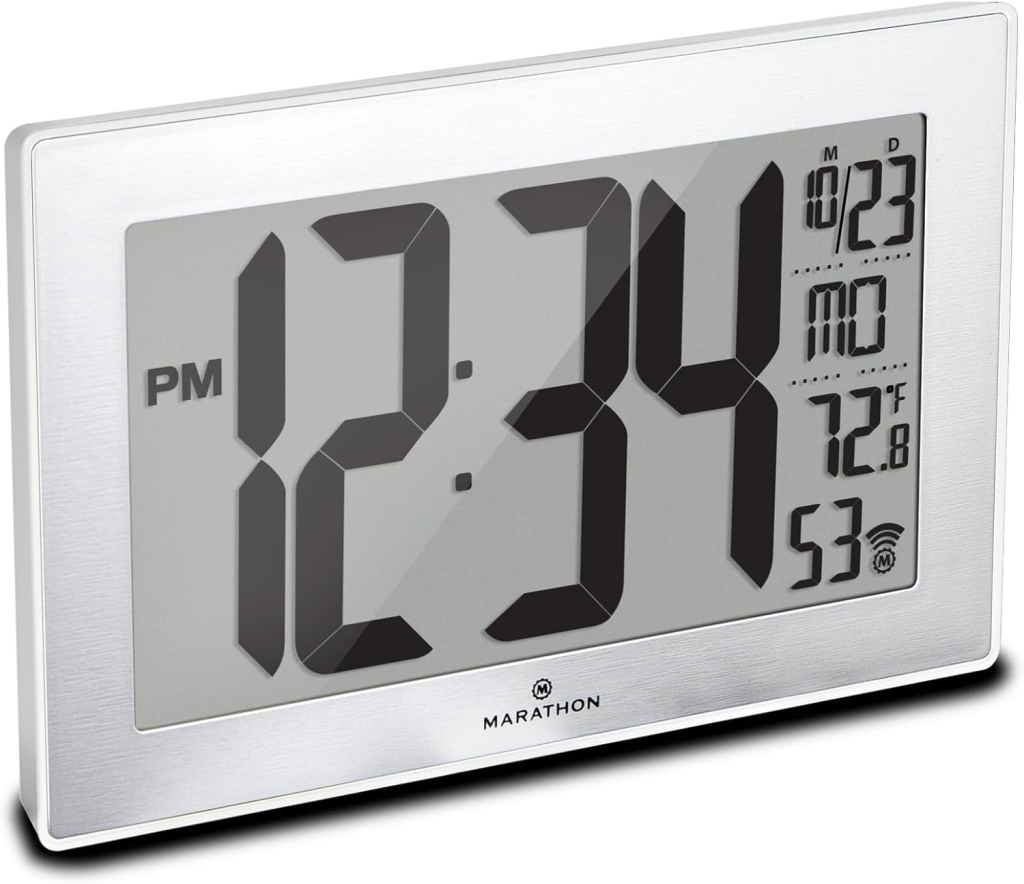
Best For: Combining traditional analog display with automatic time setting and silent operation.
Description: The Marathon Atomic Wall Clock offers the best of both worlds: a classic analog face for visual time awareness combined with atomic timekeeping technology for ultimate accuracy. It automatically sets itself to the correct time and adjusts for daylight saving, eliminating the need for manual adjustments. Many models also feature a silent sweep second hand.
What Makes It Great for ADHD:
Always Accurate: Atomic synchronization means you never have to worry about adjusting the time, removing a common executive function hurdle.
Silent Operation (on most models): Many Marathon atomic clocks feature a non-ticking sweep second hand, ensuring a distraction-free environment.
Large, Clear Display: Designed for readability, its clear analog face with bold numbers is easy to interpret at a glance.
Reliable and Low Maintenance: Once set up, it requires minimal attention, providing a consistent and accurate time reference without added cognitive load.
Potential Drawback: Can be more expensive than basic analog clocks, and atomic signal reception might vary in certain locations.
Quick Comparison Table
| Product Name | Best For | Key Feature (Visual) | Key Feature (Sound) | Price Range |
|---|---|---|---|---|
| Time Timer Plus 60 Minute | Task visualization | Disappearing red disk | Silent / Optional | $30 |
| Hippih Silent Wall Clock | General room awareness | Large, clear face | Silent | $22 |
| Acctim Remi Analogue Alarm Clock | Waking up on time | Alarm hand | Ticking / Alarm | $64 |
| Secura 60-Minute Visual Timer | Budget-friendly task timing | Disappearing red disk | Silent / Optional | $14 |
| Kikkerland Big Big Clock | High visibility in large spaces | Oversized numbers/hands | Silent / Ticking | $187 |
| School Smart Classroom Timer | Tactile, short task timing | Moving hand on dial | Loud Ticking / Ding | $12 |
| Marathon Atomic Wall Clock w/ Analog | Accurate, low-maintenance awareness | Auto-setting, clear face | Silent | $52 |
How to Stick With It: Making Analog Clocks Work for Your ADHD Brain
Getting an analog clock is the first step; consistently using it to improve your ADHD time awareness is the next. Here are five bold, actionable tips to help you make these tools an integral part of your productivity strategy:

1. Place Them Strategically Where You Need Them Most: Don’t just put one clock in your living room. Think about where you frequently lose track of time. Place a large wall clock in your main workspace, a visual timer on your desk for focused tasks, and perhaps a silent analog clock in your bedroom to help with morning routines. The more visible and accessible they are, the more likely you are to use them.
2. Practice Active Time Tracking and Observation: Simply having a clock isn’t enough; you need to engage with it. Make a conscious effort to glance at the analog clock every 15-30 minutes. Notice the position of the hands. Ask yourself: “What was I doing when the minute hand was here?” or “How much time has passed since I started this?” This active observation trains your brain to better perceive the flow of time.
3. Use Visual Timers for Every Task, Not Just Big Ones: Visual timers are incredibly powerful for breaking down “time blindness” into manageable chunks. Use them for everything: a 15-minute email sprint, a 30-minute deep work session, or even a 5-minute break. Seeing the time visually disappear helps create a sense of urgency and prevents hyperfocus or distraction from derailing your schedule.
4. Set Regular “Time Check” Reminders: If active observation is challenging, set a gentle, non-disruptive reminder (like a silent vibration on your phone or a smart watch) to prompt you to look at your analog clock every hour. This builds a habit of checking in with time, helping you re-orient yourself and adjust your pace as needed throughout the day.
5. Pair Analog Clocks with Other Time Management Strategies: Analog clocks are powerful, but they work even better when combined with other ADHD-friendly techniques. Use them with the Pomodoro Technique, body doubling, or time blocking. For instance, set your visual timer for a 25-minute Pomodoro, and then use your wall clock to track the longer breaks or overall progress through your time blocks.
FAQ Section
Q: Why are analog clocks often recommended over digital clocks for ADHD time awareness?
A: Analog clocks provide a continuous, visual representation of time as a physical quantity, showing the “sweep” of time passing, unlike digital clocks which display time as static numbers.
Q: What is “time blindness” in the context of ADHD?
A: Time blindness, or time distortion, is a common symptom of ADHD where an individual struggles to accurately perceive, estimate, and manage time. Analog clocks can help mitigate this by making time more tangible.
Q: Can visual timers really help with ADHD productivity?
A: Yes, visual timers are highly effective for improving ADHD productivity. They make the abstract concept of “time remaining” concrete and visible, which helps with starting tasks, maintaining focus, transitioning between activities, and preventing hyperfocus or distraction.
Q: Are silent analog clocks important for people with ADHD?
A: For many people with ADHD, a ticking clock can be a significant auditory distraction that disrupts focus and increases anxiety. Silent analog clocks, with a sweep second hand, eliminate this distraction, creating a calmer environment more conducive to concentration and productivity.
Q: How can I integrate analog clocks into my daily routine for better time management?
A: Start by placing them in key areas where you need time awareness most (e.g., desk, kitchen, bedroom). Make a conscious effort to glance at them regularly and actively note the time. Use visual timers for focused work blocks and transitions. Consider setting gentle reminders to prompt you to check the time. Consistency is key to building better time perception habits.
Final Thoughts
Navigating the world with ADHD can often feel like a constant battle against time, with minutes and hours slipping through your fingers. But it doesn’t have to be this way. By strategically incorporating the best analog clocks for ADHD time awareness into your environment, you’re implementing a scientifically-backed strategy that thousands of successful individuals with ADHD have used to transform their productivity. These tools transform the abstract concept of time into something you can literally see, helping your brain stay anchored in the present and prepare for the future.
At Vidalit, we believe that true productivity comes from understanding and working with your unique brain, not fighting against it. Your ADHD brain isn’t broken, it just processes information differently, and with the right tools, that difference can become your superpower.
Ready to take control of your time and unlock your productivity potential? Explore these analog clocks and find the one that helps you master your schedule today. Your future focused, punctual self will thank you!