How to Build a Personal Operating System for Deep Focus and Productivity That Actually Works Five Step Framework.
Building your own personal system for deep focus and productivity will mean the world between working hard and working for real, fast…
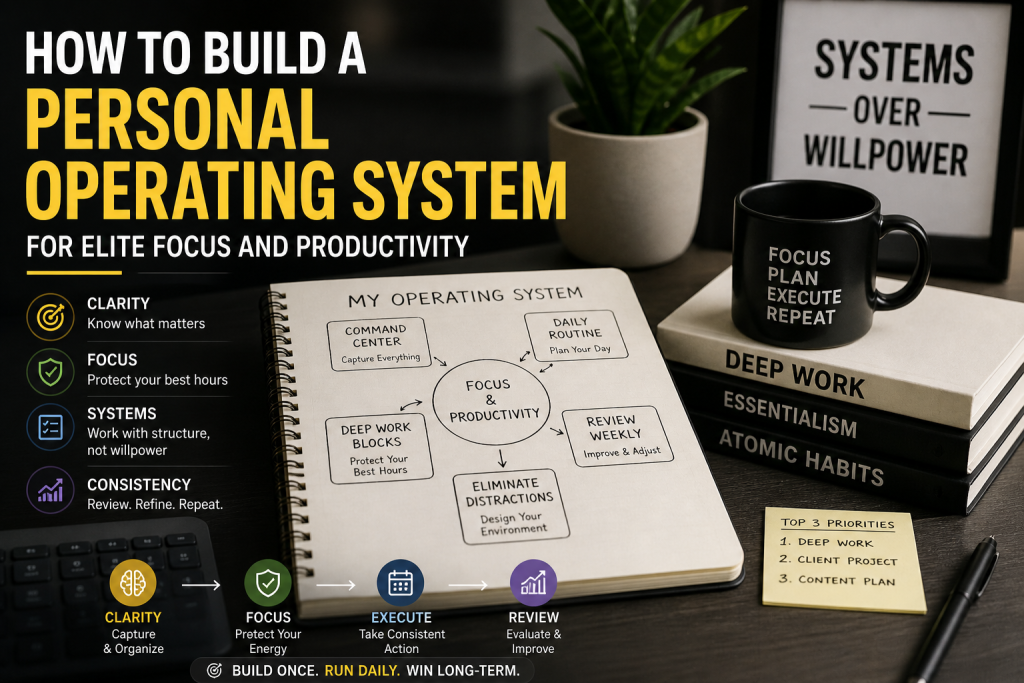
Building your own personal system for deep focus and productivity will mean the world between working hard and working for real, fast results, and a better life-changing result.
Most people aren’t unproductive because they’re lazy.
They’re unproductive because they have no system. They wake up, react to whatever demands the most attention, work randomly, and call it a day — while the work that actually matters never gets done.
That is not a willpower problem. It is a systems problem.
And for people with ADHD, this problem is amplified. When your brain already struggles with task initiation, time blindness, and working memory — trying to operate without a system is like trying to navigate a city with no map, no GPS, and the road signs keep changing.
A personal operating system fixes this. At Vida Lit, we call it a Life Operating System — a structure that runs your day so you are not just surviving it. When you build a personal productivity system that actually fits your brain and your life, everything changes. Your focus sharpens. Your output grows. The right things get done consistently without burning yourself out to get there.
Here is a five-step framework to build your personal operating system and start operating at your highest level.
Step 1: Build Your Command Center — Get Everything Out of Your Head
Your brain is not a storage device. It is a processing tool. When you use it as a to-do list, you slow it down before the real work even begins.
This is particularly true for ADHD brains, where working memory is already limited and the mental overhead of trying to remember tasks, deadlines, and commitments takes up cognitive space that should be going toward actual focused work.
The first step in any personal operating system is creating a single external place where all your tasks, ideas, and commitments live. This concept was popularized by productivity expert David Allen in his landmark book Getting Things Done — widely considered one of the most influential productivity frameworks ever written. Allen’s core principle is simple but profound — your mind is for having ideas, not holding them. When you trust an external system to capture everything, your brain is finally free to do its actual job. It does not matter whether you use a notebook, an app, or a simple document — what matters is that you actually use it every day, consistently.
Some tools worth considering for your command center:
- A physical planner for daily task management — ideal for ADHD brains that benefit from writing things down by hand
- Notion or Todoist for digital task management and project tracking
- A simple brain dump notepad kept on your desk for capturing thoughts the moment they arise
When your tasks and ideas live somewhere outside your head, your brain can do what it is actually built for — thinking clearly, solving problems, and doing deep work. Start simple. One list. One place. Every task goes there. Build the habit before you build the system.
Step 2: Protect Your Peak Hours With Time Blocking
Most people plan their day around time. High performers plan around energy. That one shift makes all the difference.
Your first two to three hours after waking are typically your sharpest cognitive window — before decision fatigue, before the demands of the day begin competing for your attention, before your limited executive function resources get depleted by a hundred small decisions. That window is where deep work needs to happen — not email, not meetings, not checking in on group chats.
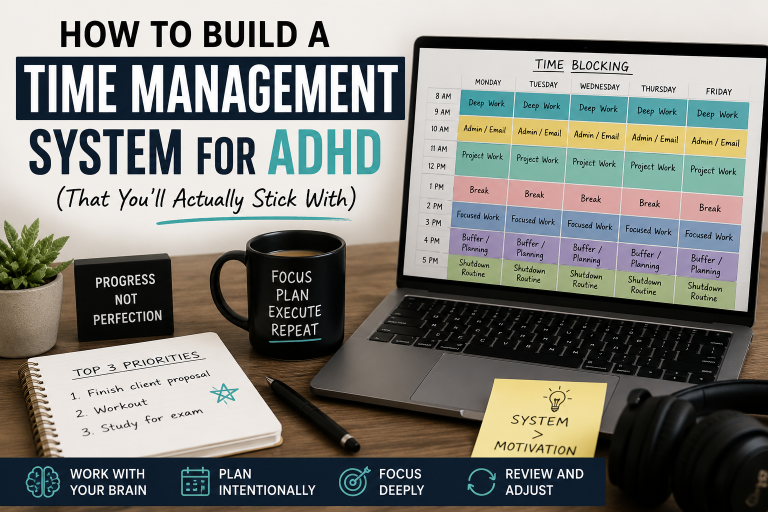
The best time blocking apps for ADHD professionals can help you protect and structure this window automatically. But even without an app, a simple time-blocking structure that works looks like this:
Morning block — your peak hours: Deep work only. Guard it like it pays your rent — because it does. This is where your most important, hardest, and highest-value work happens. No email. No Slack. No meetings.
Midday block: Calls, admin, and communication. Your energy is naturally lower here anyway — this is the right time for reactive tasks that don’t require deep cognitive effort.
End-of-day shutdown — 15 to 20 minutes: Review what you finished. Choose your top three tasks for tomorrow. Then close the laptop and stop completely.
That last step — the shutdown — matters more than most people realize. Without a defined end, your brain stays switched on and real recovery never happens. Recovery is not a reward. It is part of the system.
Step 3: Design Your Environment for Deep Focus
Willpower is not a focus strategy. It runs out — usually right when you need it most.
The better approach is to design your environment so that distraction becomes harder than focus. You are not fighting distraction with discipline alone. You are removing the conditions that make distraction easy in the first place.
Understanding how dopamine drives your focus and motivation helps here — because every distraction you interact with is triggering a small dopamine hit that makes returning to focused work harder. Environmental design cuts this cycle off at the source.
Here is what a distraction-resistant environment looks like in practice:
- Put your phone in another room or face down away from your keyboard — not next to you
- Close every browser tab not related to the task you are currently working on
- Use headphones as a signal — to yourself and to everyone around you — that you are unavailable. Noise-canceling headphones are one of the most impactful single investments you can make for your focus environment
- Work in focused blocks of 25 to 50 minutes then take a genuine short break before the next block
- Keep your desk visually clean — visual clutter competes for ADHD attention in ways that are subtle but significant
Simple? Yes. But simple works. Environment design is one of the most underrated focus improvement strategies because it removes the need for willpower entirely. When distraction requires effort, focus becomes the default.
Step 4: Build a Discipline System That Works Without Motivation
Here is something most productivity advice gets wrong.
It assumes you will always feel motivated to follow your system. You won’t. Nobody does — especially with ADHD, where motivation is neurochemically unreliable and the gap between knowing what to do and actually doing it can feel enormous.
A personal operating system that only works when you feel motivated is not a system. It is a performance you put on for yourself on good days.
The solution is building a discipline system that operates independently of how you feel. This means:
- Reducing decision points. The fewer decisions your system requires you to make in the moment, the more reliably it runs. Pre-decide your morning routine. Pre-decide your daily top three tasks the night before. Pre-decide your work blocks in advance.
- Using environmental triggers. Your environment should cue your behavior automatically — your desk set up means work mode begins, headphones on means focus session starts, laptop closed means work day ends.
- Building in accountability. Whether through a body doubling partner, a Focusmate session, or simply telling someone your daily intention, external accountability activates ADHD brains in a way that internal intention rarely does.
The goal is a system that runs even on low-motivation, low-energy, high-symptom days. Because those days will come — and your system needs to carry you through them.
Step 5: Run a Weekly Review — or the System Dies
A personal productivity system you never review slowly stops working. It becomes a list you feel guilty about rather than a system you trust.
Every week, block 30 minutes at the same time on the same day. Treat it like a standing meeting with your most important goals. During that block ask yourself three questions:
1. What did I actually finish this week? 2. What did not get done — and why? 3. What is the one thing I need to move forward next week?
This weekly review is what connects your daily actions to the goals that actually matter long-term. Without it you stay busy but go nowhere — and that is the most dangerous kind of unproductivity because it can feel exactly like progress.
The review does not need to be complicated. Thirty minutes, three questions, same time every week. That consistency is the entire point.
You can use your weekly review to also assess your cognitive focus system — checking whether your deep work environment, your focus tools, and your work blocks are still aligned with what your brain actually needs this week.
Step 6: Start Small and Let the System Compound
The most common mistake when building a personal operating system is trying to implement everything at once.
You do not need the perfect system. You need a working one.
Pick one step from this framework and build it into your week. Just one. Once it feels natural — usually within two to three weeks — add the next piece. Repeat until your full system is running.
This is the execution stack approach — layering your system from the bottom up rather than building the whole thing at once and watching it collapse under its own complexity.
A personal productivity system built gradually and consistently will outperform any elaborate setup you cannot maintain. The compounding effect of a system that actually runs is worth more than any single productivity tip you will ever read.
Nobody drifts into their best work. They build toward it — one decision and one habit at a time.
Frequently Asked Questions
What is a personal operating system? A personal operating system is a structured set of habits, routines, and tools that organizes how you manage your time, energy, and tasks each day. Unlike a simple to-do list, a personal operating system is designed to run consistently, protect your most important work, and align your daily actions with your bigger goals.
How do I start building a personal productivity system? Start with one habit — get all your tasks out of your head and into a single external system. From there add time blocking, then environment design, then a weekly review. Build one layer at a time rather than trying to overhaul everything at once.
Is a personal operating system useful for people with ADHD? Absolutely — in fact ADHD adults often benefit more from a personal operating system than neurotypical people because ADHD specifically disrupts the internal executive function that a system replaces externally. A well-designed personal operating system compensates for time blindness, working memory deficits, and task initiation difficulty in ways that willpower and good intentions never can.
How long does it take to build a personal operating system? Most people find a basic version of their system working within two to four weeks if they focus on one piece at a time. The system improves over time — the goal is not perfection on day one but consistency over months.
What tools do I need to build a personal operating system? You need surprisingly little. A task capture system — notebook or app, a calendar for time blocking, and a weekly review template are enough to get started. As your system matures you can add focus tools like noise-canceling headphones, distraction blockers, and productivity apps. But the foundation is behavioral not technological.
Your Life Deserves an Operating System
Nobody drifts into their best work. They build toward it — with intention, structure, and a system that shows up even on the days their motivation does not.
A personal operating system is not about adding more to your plate. It is about making sure the right things get done consistently — without burning out in the process.
Start with Step 1 today. Get everything out of your head and into one place. Then come back tomorrow and add the next layer.
From my experience, building this kind of system changed everything for me. I spent years feeling productive but getting nowhere — busy all day, but the work that actually mattered kept getting pushed to tomorrow. When I finally built a real system around how my brain actually works — not how I thought it should work — the shift was immediate. Less chaos. More clarity. More of the right things getting done. Start with one step. That is genuinely all it takes to begin.