Discipline System: 5 Proven Ways to Build Behavior That Doesn’t Depend on Mood
A discipline system is what separates people who perform consistently from people who only perform when they feel like it. Most people…
A discipline system is what separates people who perform consistently from people who only perform when they feel like it. Most people treat discipline as an emotional state — something you either feel on a given day or you don’t. They wait for motivation, for the right mood, for the moment they finally feel “ready.” The problem is that emotions are unreliable by nature. Motivation is high some days and completely gone on others.
High performers do not rely on feelings. They build a discipline system — a set of routines, environments, and structures that make productive behavior automatic regardless of mood. Discipline, in this sense, becomes infrastructure. It is not a personality trait you are born with or without. It is something you design and build deliberately.
This systems-based approach sits at the core of Vida Lit’s Life Operating System philosophy — and it is one of the most important mindset shifts you can make if you are serious about focus, productivity, and long-term growth.
What Is a Discipline System and Why Does It Work?
A discipline system is a set of deliberately designed habits, environments, and routines that produce consistent behavior without requiring willpower or motivation as fuel.
The reason this matters comes down to how the brain actually works. Psychological research on ego depletion shows that self-control draws on finite cognitive resources that get depleted throughout the day. The more decisions you make, the harder it becomes to maintain effort and resist distraction as the hours pass. Willpower is not a bottomless well — it is a limited daily resource.
This is why so many goals — workout programs, writing habits, time management plans — start strong and quietly collapse after a few weeks. The initial motivation runs out, and there is no discipline system underneath to keep the behavior going.
When behavior is built into routine and environment instead of relying on motivation, consistency becomes dramatically easier to maintain. The goal of a discipline system is to make good behavior the path of least resistance — so you do the right thing not because you feel like it, but because the system makes it natural.
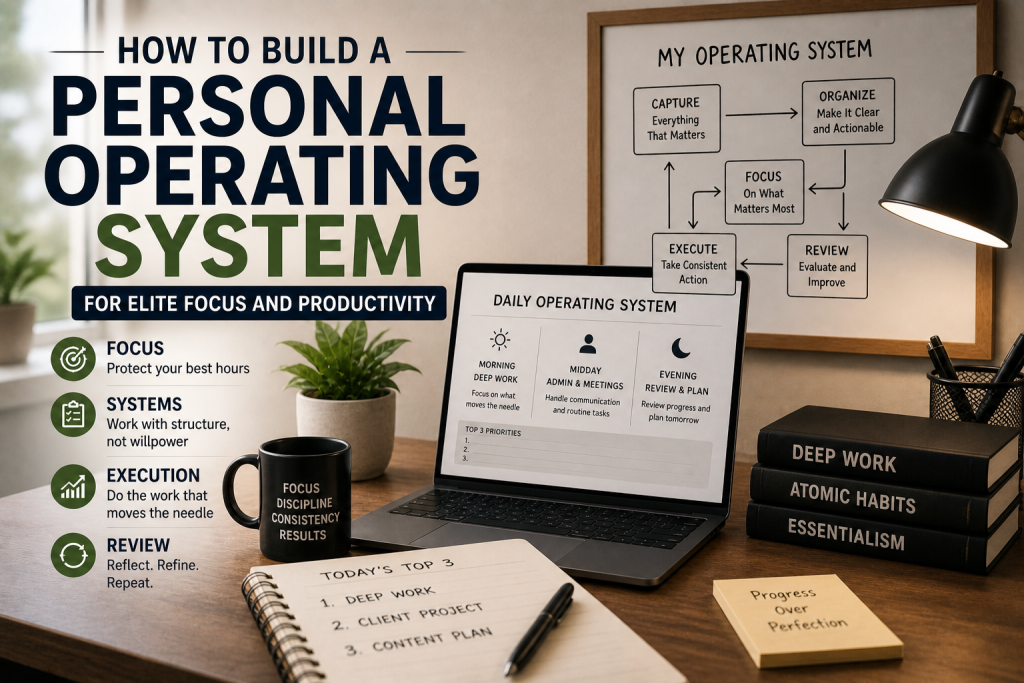
How to Build a Personal Operating System
5 Strategies to Build a Discipline System That Works Without Motivation
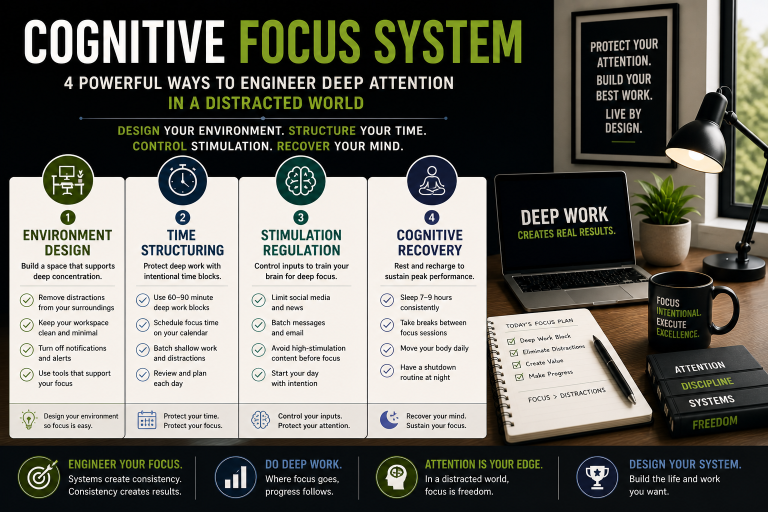
Strategy 1: Design Your Environment Before You Need Willpower
Environmental design is one of the most powerful and underused tools in building a discipline system. Behavioral research consistently shows that small environmental changes have an outsized impact on decision-making and habit formation — often more than motivation or intention ever could.
The core principle is simple: reduce friction on the behaviors you want, and increase friction on the behaviors you want to avoid.
Here is what that looks like in practice:
- Lay out your workout clothes the night before — removing the barrier makes it easier to exercise in the morning without a mental debate.
- Keep your workspace clean and clear — a low-resistance environment lowers the activation energy needed to start focused work.
- Put your phone in another room during deep work hours — when distraction requires effort, focus becomes the default.
- Use website blockers or app limits during your most important work blocks — the less access you have to distraction, the stronger your discipline system becomes.
You are not fighting your impulses with this approach. You are redesigning the conditions so the right behavior is simply the easiest one available.
Strategy 2: Build Non-Negotiable Rules Into Your Discipline System
One of the fastest ways to strengthen a discipline system is to remove decisions entirely. When a behavior is not a choice — when it is just what you do at a certain time — it requires almost no mental energy to execute.
A daily deep-work block that starts at the same time every morning. A fixed training schedule. A non-negotiable sleep window. These are not rigid rules that limit freedom. They are the architecture of a discipline system that runs on autopilot.
The less you have to decide, the more energy you have for the actual work. Decision fatigue is real, and a strong discipline system protects you from it by making your most important behaviors automatic.
Start with one non-negotiable. Same time, every day, no exceptions. Build from there.
Strategy 3: Use Identity to Reinforce Your Discipline System
Over time, consistent actions begin to shape how you see yourself — and identity is one of the most powerful drivers of long-term behavior.
Someone who writes every morning eventually stops asking whether they feel like writing. They are a writer. That is what writers do. Someone who trains consistently stops debating whether to go to the gym. They are someone who trains. The habit becomes a natural extension of who they believe they are.
This is identity-based reinforcement, and it is a core mechanism inside any lasting discipline system. When your behavior aligns with your self-perception, you rarely question it. You just do it.
The practical implication: start calling yourself what you want to become, and let your discipline system close the gap between the label and the reality.
Strategy 4: Reduce Decision Points Throughout Your Day
Every decision you make draws on the same cognitive resources your discipline system depends on. The more you can eliminate low-value decisions from your day, the more capacity you preserve for the work that matters.
This is why many high performers — from athletes to executives — standardize parts of their day that most people leave to chance. Meal prep removes daily food decisions. A fixed morning routine eliminates choices about how to start the day. A shutdown ritual ends the workday the same way every time.
According to research published by the American Psychological Association, decision fatigue significantly impairs self-regulation over the course of a day. Your discipline system should be designed to protect your best hours from unnecessary decisions, not just from external distractions.
Strategy 5: Track, Review, and Strengthen Your Discipline System Weekly
A discipline system that is never reviewed slowly degrades. Habits drift. Non-negotiables become negotiable. The weekly review — a consistent, structured check-in with your own behavior — is what keeps the system sharp.
Every week, ask yourself:
- Which behaviors ran automatically this week — and which required effort?
- Where did I break my own rules, and what made it easy to do so?
- What is one friction point I can remove or one rule I can tighten?
This review does not need to be long. Twenty to thirty minutes, once a week, is enough to catch drift before it becomes collapse. The goal is not to judge yourself — it is to treat your discipline system like the infrastructure it is, and do regular maintenance on it.
Why a Discipline System Outlasts Motivation Every Time
Motivation is a feeling. Feelings are temporary. A discipline system is a structure — and structures hold even when feelings don’t.
When you build your discipline system around environment design, non-negotiable rules, identity reinforcement, reduced decisions, and regular reviews, you are no longer dependent on waking up inspired. You are operating on infrastructure that runs whether motivation shows up or not.
This is the foundation of the Life Operating System philosophy at Vida Lit. Discipline is not about being harder on yourself. It is about building something smarter around yourself — a system that handles the consistency, so you can focus on the growth.
Frequently Asked Questions About Building a Discipline System
What is a discipline system? A discipline system is a set of deliberately designed habits, routines, and environmental structures that produce consistent behavior without relying on motivation or willpower. It makes productive behavior the path of least resistance.
Why does motivation fail but a discipline system works? Motivation is emotion-dependent and temporary. Research on ego depletion shows that willpower is a finite resource that gets drained throughout the day. A discipline system removes the need for willpower by automating behavior through routine and environment design.
How do I start building a discipline system? Start with one non-negotiable behavior at the same time every day. Then design your environment to reduce friction around that behavior. Add a weekly review after two weeks to track what is working and what needs adjustment.
How long does it take for a discipline system to become automatic? Research suggests habits take anywhere from 18 to 254 days to become automatic, with an average around 66 days according to a study published in the European Journal of Social Psychology. The key is consistency in the early weeks, which is exactly what a well-designed discipline system is built to protect.
Your Discipline System Starts With One Decision
Nobody builds a reliable discipline system overnight. But everyone starts with one decision: to stop waiting for motivation and start building the structure that makes motivation irrelevant.
Vida Lit is built around exactly this idea.