Life Operating System: The Powerful Framework That Transforms How You Live and Work
A Life Operating System is the invisible framework beneath every decision you make, every habit you keep, and every result you produce…
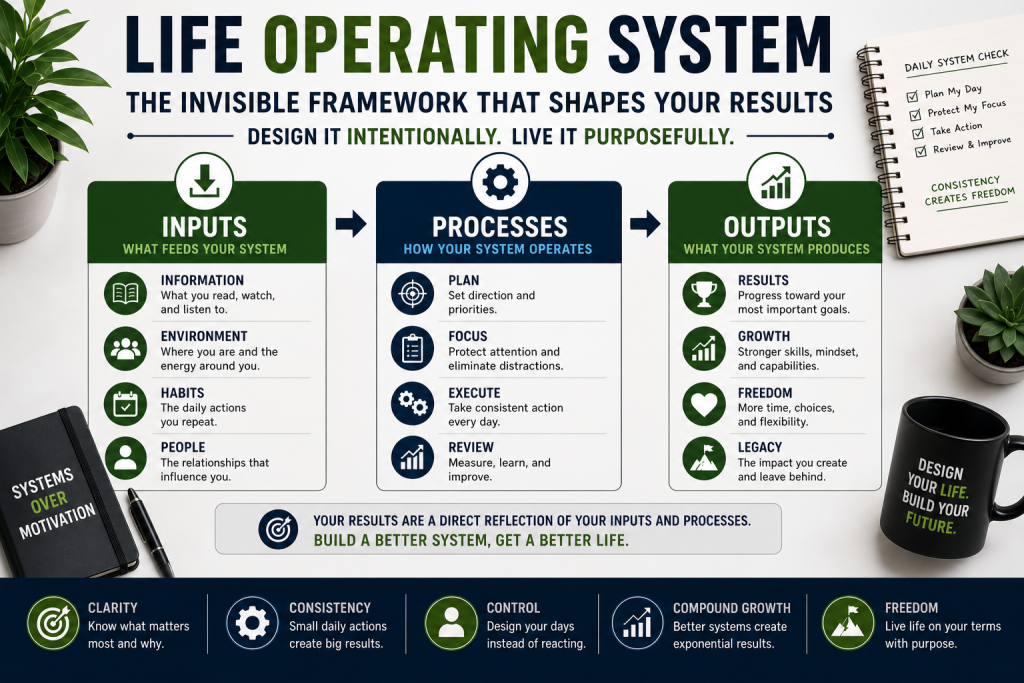
A Life Operating System is the invisible framework beneath every decision you make, every habit you keep, and every result you produce — and most people have never intentionally designed one.
Think about how a computer works. Every device runs on an operating system: an invisible architecture that determines how programs run, how resources get allocated, and how tasks are processed. Without it, even powerful hardware becomes chaotic and inefficient. It does not matter how much potential the machine has. Without a functioning system underneath, nothing runs reliably.
Your life works the same way. Beneath your daily actions lies a system of habits, decisions, and environments that quietly shape your outcomes whether you designed them or not. When that system is unstructured, progress becomes accidental — driven by temporary motivation, external pressure, and whatever happens to grab your attention on a given day.
At Vida Lit, we call the intentional version of this a Life Operating System: a structured framework that organizes your focus, energy, choices, and development into a coherent, reliable structure. This is not a productivity hack or a motivational concept. It is the foundational architecture that everything else in the Vida Lit framework is built on.
Here is how the Life Operating System works — and how to start building yours.
Why Most People Operate Without a Life Operating System
The reason most people never build a Life Operating System is not laziness. It is that no one ever taught them they needed one.
Instead of designing the system that governs their behavior, most people default to a set of temporary drivers:
- Motivation — powerful in the moment, but it fluctuates constantly and cannot be relied on for consistent execution.
- External pressure — deadlines and accountability can push action, but only while the pressure exists. Remove it and the behavior stops.
- Short-term goals — bursts of effort without long-term structure behind them produce bursts of progress that fade quickly.
Without a Life Operating System holding these drivers together, habits become unstable, attention scatters between tasks, and decisions get made reactively instead of strategically.
Modern environments make this significantly harder. Research on decision fatigue shows that the quality of decisions declines as mental resources deplete throughout the day — and the average person now makes hundreds of small decisions daily while managing a constant stream of notifications, digital content, and competing demands. When life is lived in a permanent state of reaction, progress becomes unpredictable and inconsistent.
A Life Operating System solves this by replacing reaction with intentional design.
The Architecture of a Life Operating System
Every functional system — technological or personal — has a clear architecture. The Life Operating System is built on three foundational layers: Inputs, Processes, and Outputs.
Layer 1: Inputs — What Feeds Your Life Operating System
Inputs are everything that influences your thinking and behavior: the information you consume, the environments you spend time in, the habits you practice daily, and the people who shape your perspective.
Inputs matter because they are upstream of everything else. What you feed your Life Operating System determines the quality of everything it produces. High-quality inputs — useful information, productive environments, relationships that challenge and support you — lead to better decisions and stronger performance. Poor inputs — constant distraction, negative environments, low-quality content — quietly degrade the entire system over time.
The most overlooked input is your digital environment. The content you consume daily, the accounts you follow, the apps on your home screen — these are all inputs actively shaping your thinking whether you are aware of them or not.
Audit question: What information am I consuming daily, and is it moving me closer to or further from the outcomes I want?
Layer 2: Processes — How Your Life Operating System Operates
Processes are the systems you use to operate on a daily basis: your planning routines, decision-making frameworks, productivity systems, and structured workflows. They determine how inputs get converted into action.
Someone with clear, well-designed processes — a weekly planning session, dedicated focus blocks, a consistent morning routine — will consistently outperform someone whose work is based on improvisation, regardless of raw talent or effort. Research on habit formation confirms that structured routines reduce cognitive load and improve consistency by removing the need to make repeated decisions about what to do next.
Processes are the operational layer of your Life Operating System. They are what turn intention into execution, week after week.
Design question: What planning systems, productivity routines, and daily structures do I have in place — and are they producing the results I want?
Layer 3: Outputs — What Your Life Operating System Produces
Outputs are the results your system generates: your health, income, knowledge, skills, relationships, and quality of life. These are what most people focus on when they want to improve their lives.
The critical insight inside the Life Operating System framework is this: trying to change outputs without changing the inputs and processes that produce them is the most common and costly mistake in personal development. You cannot sustainably improve results by working harder within a broken system. You have to redesign the system itself.
When the architecture is intentionally built — when inputs are upgraded and processes are structured — better outputs emerge naturally and consistently, without requiring extraordinary willpower or motivation to sustain them.
The 5 Control Variables of Your Life Operating System
Within the Life Operating System framework, five key variables act as levers that directly shape system performance. Adjusting any one of them produces ripple effects across the entire system.
1. Focus
Where attention goes, energy and results follow. A Life Operating System that protects focus — through time blocking, environment design, and distraction management — allows effort to accumulate toward goals that actually matter instead of scattering across whatever demands attention in the moment.
2. Energy
Physical and mental energy determine your capacity to execute. Sleep quality, physical activity, nutrition, and recovery habits all directly influence how much you bring to your work and learning each day. A Life Operating System that ignores energy management is running on a depleted battery.
3. Money
Financial stability is a structural resource. It provides options, reduces chronic stress, and enables long-term decision-making instead of short-term survival choices. Managing money as a control variable means treating financial health as a system input, not an afterthought.
4. Environment
Physical spaces, digital tools, and social environments influence behavior more than most people realize. Behavioral research consistently shows that environmental design shapes decisions automatically — often more powerfully than intention or willpower. A well-designed environment makes productive behavior easier and distraction less accessible.
5. Standards
Standards are the personal rules that define how you operate — how you manage time, what behaviors are acceptable, what level of performance you expect from yourself. High standards built into a Life Operating System create a behavioral floor that holds even when motivation is low.
These five variables are deeply interconnected. Improving sleep raises energy. Higher energy sharpens focus. Better focus increases the quality and output of work. Small, deliberate adjustments in one variable compound across the entire Life Operating System over time.
How to Install Your Life Operating System in 4 Steps
Building a Life Operating System does not require a complete life overhaul. It requires four deliberate steps, executed consistently over time.
Step 1: Audit Your Inputs
Examine everything that influences your thinking and behavior daily. What information are you consuming? What environments are shaping your habits? Which routines support your goals and which ones quietly undermine them? Improving inputs is often the fastest single upgrade available to your Life Operating System.
Step 2: Design Your Processes
Build the planning systems and productivity routines that guide your daily actions. A weekly planning session to clarify priorities. Daily focus blocks for your most important work. A shutdown ritual to end each day with intention. Structured processes reduce uncertainty and protect mental energy from unnecessary decisions.
Step 3: Define Your Standards and Non-Negotiables
Set the baseline rules that govern your behavior regardless of mood or circumstance. Protected deep work sessions. Consistent exercise. Dedicated learning time. When non-negotiables are built into your Life Operating System, the decision of whether to do them is already made — which removes the friction that kills most habits.
Step 4: Track and Adjust Your Outputs
Observe what your system is producing. Are your habits improving your health, productivity, and financial stability? Are you making measurable progress toward long-term goals? If the outputs do not match what you want, adjust the inputs or redesign the processes. A Life Operating System improves through consistent review and deliberate iteration — not through occasional bursts of motivation.
Frequently Asked Questions About the Life Operating System
What is a Life Operating System? A Life Operating System is a structured personal framework — built on inputs, processes, and outputs — that organizes your focus, energy, habits, and decisions into a coherent system. Instead of relying on motivation or reacting to circumstances, a Life Operating System gives you a reliable architecture for consistent growth and performance.
Why do I need a Life Operating System? Without a deliberately designed Life Operating System, your behavior is governed by default patterns, temporary motivation, and external pressure — none of which produce consistent long-term results. A Life Operating System replaces reaction with intentional design, so your daily actions compound toward the outcomes that matter most.
How is a Life Operating System different from a productivity system? A productivity system focuses on managing tasks and time. A Life Operating System is broader — it governs inputs, processes, outputs, and the five control variables (focus, energy, money, environment, and standards) that determine overall life performance. Productivity is one output of a well-functioning Life Operating System, not the whole system itself.
How long does it take to build a Life Operating System? A basic, functional Life Operating System can be in place within two to four weeks if built one layer at a time. Like any operating system, it improves through consistent use, regular review, and deliberate iteration over months and years.
Your Life Operating System Is Already Running — The Question Is Whether You Designed It
Whether you have intentionally built a Life Operating System or not, one is already operating beneath your daily decisions, habits, and results. The only question is whether it was designed by you — or assembled by default from whatever inputs, pressures, and patterns happened to show up first.
Vida Lit exists to help you design it deliberately. The Life Operating System is the foundation of everything we build here — and every framework, strategy, and system we publish connects back to this core architecture.