How to Use Time Blocking If You Have ADHD (Without Feeling Restricted)
This blog may contain affiliate links. We may receive a commission at no extra cost to you. Your support helps keep this…
If you’ve ever created the perfect schedule only to completely ignore it a few hours later, you’re not alone.
One of the biggest challenges of ADHD is that traditional productivity advice often feels too rigid. We start the day with good intentions, get distracted, hyperfocus on something unexpected, or underestimate how long things will take.
That’s where time blocking can help.
When used correctly, time blocking isn’t about controlling every minute of your day. It’s about giving your time a purpose before distractions decide it for you.
In this guide, I’ll show you how to use time blocking if you have ADHD, the mistakes that make it fail, and the simple system that has worked best for me.
What Is Time Blocking?
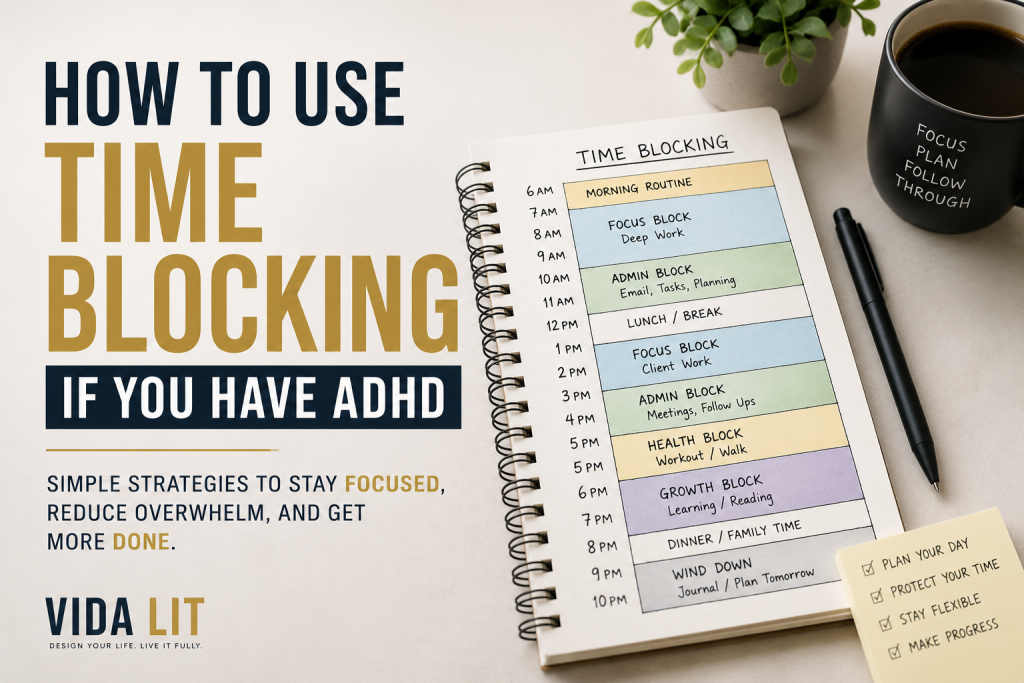
Time blocking is the practice of assigning specific blocks of time to specific activities.
Instead of creating a giant to-do list, you schedule when you’ll work on important tasks.
For example:
- 7:00 AM – Morning routine
- 8:00 AM – Work
- 12:00 PM – Lunch
- 6:00 PM – Exercise
- 7:00 PM – Knowledge work
The goal is simple:
Instead of constantly asking yourself what to do next, you already know.
This reduces decision fatigue and helps you stay focused on the task in front of you.
Use time blocking for very specific tasks and not for every single aspect of your life or you will end up with adhd paralysys.
For me, I use what I call my Focus Mode. My daily rule is to work for 2 hours of uninterrupted knowledge work. I set a timer on my Pomodoro app on my laptop. This way, I can see the time running out, and it keeps me focused and motivated.
This time could be used to work on my blog, update my budget, or organize my to-do list. I know that for me, this allotted focus block sets me up for success in what I want to achieve.
Why Time Blocking Works for ADHD
One of the biggest struggles with ADHD is time blindness.
Time often feels invisible until it’s gone.
You sit down for “a few minutes” and suddenly an hour disappears.
Time blocking helps make your day visible.
Instead of hoping you’ll find time for important things, you’re intentionally creating it.
The Biggest Mistake ADHDers Make
Most people create unrealistic schedules.
They plan every hour perfectly.
Then life happens.
A meeting runs long.
You get interrupted.
You hyperfocus.
Now the entire schedule is broken.
This is why many people with ADHD think time blocking doesn’t work.
The problem isn’t time blocking.
The problem is creating blocks that are too rigid.
Use Flexible Time Blocks Instead
My Personal Rule
Use Flexible Time Blocks instead of more general rules.
Or my rule of doing no more then 1hr at the gym.
One of the best decisions I’ve ever made was committing to between 30 minutes and 2 hours of knowledge work every day. Started with me only being able to focus for 5 minutes. Now I can go for up to 2 hours with barely any breaks.
That time might be spent:
- Writing for Vida Lit
- Reading a book
- Updating my budget
- Working on a side hustle
- Planning my goals
The specific activity changes.
The block remains.
This follows the same principle I discuss in The Art of Making One-Time Life-Changing Decisions: make important decisions once so you don’t have to keep making them every day.
Time Blocking and the Pomodoro Technique
Another strategy that works extremely well for ADHD is combining time blocking with the Pomodoro Technique.
For example:
Growth Block (7:00 PM – 8:00 PM)
Inside that block:
- 25 minutes focused work
- 5 minute break
- 25 minutes focused work
- 5 minute break
This creates urgency and helps prevent your attention from drifting.
The Best Tools for ADHD Time Blocking
The good news is you don’t need anything fancy.
A calendar works.
A notebook works.
A planner works.
That said, some tools make the process easier.
You might find these guides helpful:
- Best Weekly Planners for ADHD Professionals That Actually Work
- Best Productivity Watches for ADHD
- Best Time Tracking Software for ADHD Freelancers
The best tool is the one you’ll actually use consistently.
Keep Empty Space in Your Schedule
Remember these rules I live by: Eliminate, Delegate, Compromise, or Accept
Learn to let go. The main things will get done. You will show up to work, pay your bills and figure out a way to buy food to survive. You don’t need to schedule those things in your calendar.
Schedule only set appointments, birthdays, and meetings.
Only set a block of time to be dedicated to being productive on the thing that will move you closer towards the life you want.
Set a 4-hour block dedicated to only doing the most productive work.
Once your main things for the day are done, relax and forget about everything else. What needs to be done will get done. Learn to let go, and you won’t feel overwhelmed.
The purpose of doing all this work is to live the life you want now and not hopefully someday. We can already be present to the good things we already have.
This might be the most important tip in the entire article.
Do not schedule every minute of your day.
Leave breathing room.
ADHD brains are notoriously optimistic about how long things take.
Build buffer blocks between major activities.
A schedule with flexibility is far more sustainable than a schedule that’s perfect on paper.
Start Small
Don’t try to time block your entire life tomorrow.
Start with one block.
Maybe it’s:
- 30 minutes of exercise
- 30 minutes of reading
- 30 minutes working on a goal
Build trust with yourself first.
Then expand.
Remember:
The goal isn’t creating the perfect schedule.
The goal is making sure the things that matter actually get time.
Take Action
Open your calendar right now.
Choose one activity you’ve been putting off.
Schedule a 30-minute block for it tomorrow.
That’s it.
Don’t overthink it.
One block is enough to start building the habit.
Final Thoughts
Learning how to use time blocking if you have ADHD isn’t about becoming more rigid.
It’s about becoming more intentional.
ADHD can make it difficult to stay aware of time, prioritize tasks, and follow through consistently. Time blocking creates a simple structure that helps reduce those challenges without requiring perfect discipline.
Start small.
Keep it flexible.
Focus on consistency instead of perfection.
Over time, you’ll discover that time blocking isn’t about controlling your day.
It’s about making sure your day doesn’t control you.
Related Articles
- How to Manage Time With ADHD as a Busy Professional
- Best Weekly Planners for ADHD Professionals That Actually Work
- Best Productivity Watches for ADHD
- Best Time Tracking Software for ADHD Freelancers
- The Art of Making One-Time Life-Changing Decisions