Dopamine and Productivity: 5 Proven Strategies to Fix Your Focus and Motivation
Dopamine and productivity are more connected than most people realize — and understanding that connection might be the single most important shift…
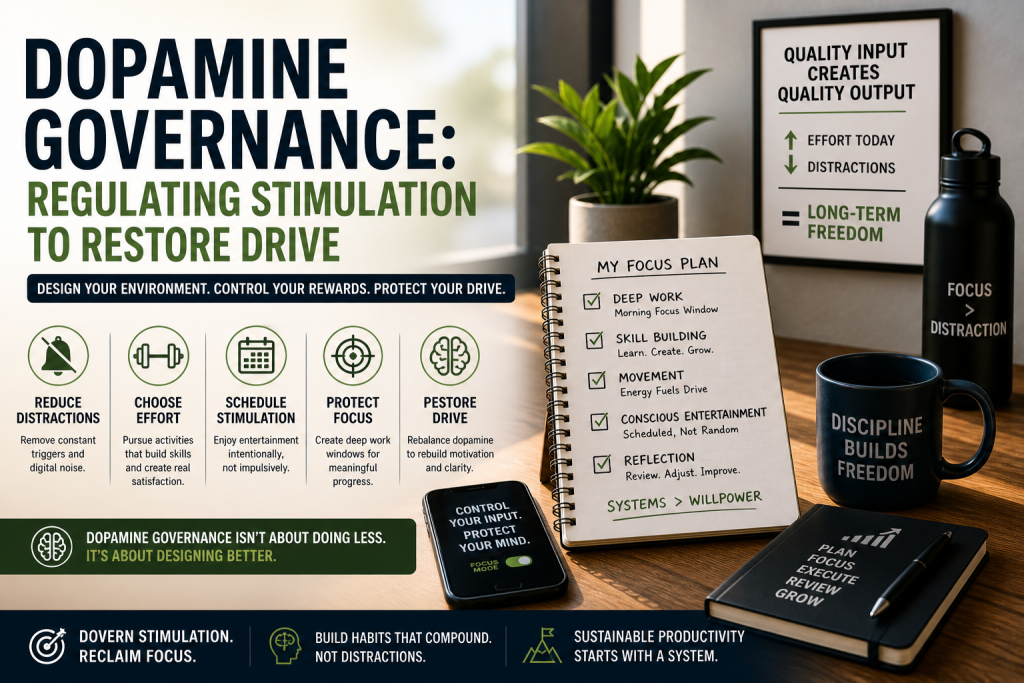
Dopamine and productivity are more connected than most people realize — and understanding that connection might be the single most important shift you can make for your focus, motivation, and follow-through.
If you have ever sat down to do important work and found yourself reaching for your phone instead, that is not a discipline problem. It is a stimulation problem. Modern digital platforms are engineered specifically to compete for your attention, delivering rapid, unpredictable reward signals that make low-effort entertainment feel easier and more appealing than meaningful work.
The good news is that this is a solvable problem. At Vida Lit, we address it through what we call dopamine governance — the deliberate management of your stimulation environment so that motivation and attention work in your favor instead of against you. It is not about eliminating enjoyment. It is about building a system that keeps your brain calibrated for the work that actually matters.
Here are 5 proven strategies to take control of dopamine and productivity in your daily life.
Why Dopamine and Productivity Are Inseparable
Before diving into the strategies, it helps to understand what dopamine actually does — because it is widely misunderstood.
Dopamine is not simply a “pleasure chemical.” Neuroscientists describe it more accurately as a motivation and reward prediction signal. It helps the brain anticipate rewards and drives goal-directed behavior. In a healthy, well-regulated system, dopamine positively reinforces productive behaviors like deep work, learning, and physical training.
The problem is that modern digital platforms have been deliberately engineered to hijack this system. Notifications, social feeds, short-form video, and algorithmic content streams deliver unpredictable, rapid dopamine hits that the brain finds highly compelling. Research published in behavioral neuroscience shows that unpredictable rewards are particularly effective at sustaining engagement, which is exactly why these platforms are so difficult to put down.
Over time, constant exposure to high-stimulation inputs causes the brain to recalibrate. Slower, effort-based activities — the kind that actually build skills, income, and meaningful progress — start to feel dull and difficult by comparison. The result is procrastination, scattered attention, and a creeping inability to do deep work.
This is the dopamine and productivity problem. And it is structural, not personal.
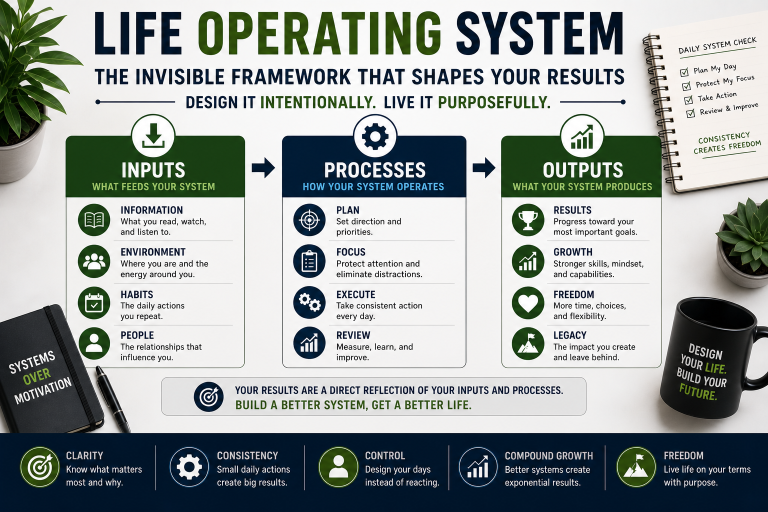
Build a Personal Operating System
The Stimulation Overload Loop
Most people stuck in low productivity are caught in a predictable cycle that looks like this:
- Instant reward: Check notifications, scroll social media, watch short-form content.
- Dopamine spike: The brain receives an immediate reward signal and registers satisfaction.
- Motivation crash: When the stimulation ends, demanding tasks feel even harder by contrast.
- Seeking the next hit: The brain looks for another easy stimulation source to recover the feeling.
Repeat this loop dozens of times a day and the brain gradually trains itself to prefer easy dopamine over effort-based progress. Breaking the cycle does not require eliminating all entertainment or becoming a monk. It requires intentional management of your stimulation inputs — which is exactly what dopamine governance is designed to do.
5 Proven Strategies to Manage Dopamine and Productivity
Strategy 1: Control Your High-Stimulation Inputs
The first step in managing dopamine and productivity is reducing the constant stream of digital triggers that interrupt your day. This does not mean quitting social media entirely — it means removing the automatic, impulsive access to it during your most important hours.
Practical steps to start immediately:
- Turn off all non-essential notifications on your phone and computer.
- Remove social media and entertainment apps from your work devices entirely.
- Keep your phone in another room during deep work blocks — physical distance is more effective than willpower.
- Use app blockers or screen time limits during your peak focus hours.
These are not dramatic lifestyle changes. They are small environmental adjustments that significantly reduce the pull of easy dopamine during the hours when your attention matters most.
Strategy 2: Replace Passive Stimulation With Effort-Based Rewards
One of the most effective dopamine and productivity strategies is replacing passive, low-effort stimulation with activities that require genuine engagement.
Exercise, skill development, reading, creative work, and meaningful conversation all deliver dopamine — but through a slower, more sustainable pathway. Studies on effort-based reward show that activities requiring real effort produce more durable motivation than instant digital rewards, and that the sense of accomplishment following effortful work is a powerful reinforcer of continued behavior.
The practical shift: when you feel the urge to reach for passive stimulation, redirect toward a low-barrier version of an effortful activity. A 10-minute walk. A page of reading. A focused work sprint. You are not suppressing the desire for reward — you are redirecting it toward something that actually builds momentum.
Strategy 3: Schedule Stimulation Intentionally
Entertainment is not the enemy of dopamine and productivity. Unstructured, unscheduled consumption is.
The difference between watching a show that genuinely relaxes you and mindlessly scrolling for two hours is intention. When you decide in advance when and how long you will engage with high-stimulation content, you maintain control over your reward system instead of surrendering it to the platform’s algorithm.
A simple framework:
- Designate specific windows for social media, streaming, and entertainment — outside of your peak work hours.
- Treat those windows as scheduled recovery, not default behavior.
- When the window ends, close the app and move on.
This single shift — moving from reactive consumption to scheduled consumption — dramatically changes the relationship between dopamine and productivity in your daily life.
Strategy 4: Protect Your Deep Work Windows
Dopamine and productivity research consistently points to one of the most important variables in cognitive performance: uninterrupted focus time. The brain needs sustained, distraction-free periods to engage in the kind of deep work that produces real results.
Even 60 to 90 minutes of uninterrupted focus has a measurable positive impact on task completion and cognitive output, according to research on attention and flow states. Cal Newport, author of Deep Work, argues that the ability to perform deep, focused work is becoming increasingly rare — and increasingly valuable — in a world of constant distraction.
Protect your deep work windows by:
- Blocking the same focus hours every day — consistency trains the brain to expect deep work at that time.
- Using headphones as a signal that you are unavailable.
- Starting with 25-minute focused blocks if 90 minutes feels difficult, and building from there.
- Keeping a notepad nearby to capture interrupting thoughts without acting on them immediately.
The goal is to make deep focus a daily non-negotiable inside your dopamine governance system — not something you try to squeeze in when everything else is done.
Strategy 5: Build a Recovery Ritual That Resets Your Reward System
The final piece of the dopamine and productivity puzzle is intentional recovery. Most people either collapse into passive stimulation at the end of the day or keep pushing until they burn out. Neither approach restores the reward system effectively.
A deliberate recovery ritual — a consistent end-of-day routine that signals to your brain that work is done and genuine rest is beginning — helps reset dopamine baseline levels so you wake up the next day with motivation intact.
Your recovery ritual might include:
- A short walk without headphones or a phone.
- Journaling for 5 to 10 minutes about what you accomplished.
- Reading fiction or something unrelated to work.
- A consistent sleep and wind-down window that does not involve screens.
The goal is not to eliminate stimulation entirely in the evenings. It is to choose lower-stimulation recovery that allows your dopamine system to recalibrate overnight, so the next morning’s focus window starts from a strong baseline.
Frequently Asked Questions About Dopamine and Productivity
How does dopamine affect productivity? Dopamine acts as a motivation and reward prediction signal in the brain. When the dopamine system is well-regulated, it reinforces productive, effort-based behavior. When it is overstimulated by constant digital inputs, meaningful work starts to feel harder and less rewarding by comparison — directly reducing focus and follow-through.
What is dopamine governance? Dopamine governance is the intentional management of stimulation inputs to keep motivation and attention calibrated for deep work and long-term goals. It is a core component of the Vida Lit Life Operating System and focuses on environmental design rather than willpower.
How do I reset my dopamine system for better productivity? Start by reducing high-stimulation inputs during work hours, scheduling entertainment intentionally rather than consuming it reactively, and protecting at least one daily deep work window from all interruptions. Consistency over two to four weeks produces noticeable improvements in motivation and focus.
Is social media bad for productivity? Social media itself is not the problem — unregulated, impulsive access to it is. Scheduling social media consumption intentionally, rather than checking it reactively throughout the day, significantly reduces its negative impact on dopamine and productivity.
The Bottom Line on Dopamine and Productivity
Most productivity struggles are not caused by laziness or lack of discipline. They are caused by an unregulated stimulation environment that has quietly recalibrated the brain to prefer easy rewards over meaningful work.
By learning to govern dopamine — reducing impulsive stimulation, replacing passive consumption with effort-based rewards, scheduling entertainment intentionally, protecting deep work windows, and building recovery rituals — you can gradually restore the motivation and clarity that distraction has been slowly draining.
This is what the Vida Lit Life Operating System is built on: not fighting your environment with sheer willpower, but designing an environment that makes focus and consistency the natural default.