The Execution Stack: 3 Powerful Layers That Turn Vision Into Real Results
The Execution Stack is the productivity framework that finally answers one of the most frustrating questions high performers face: why does working…
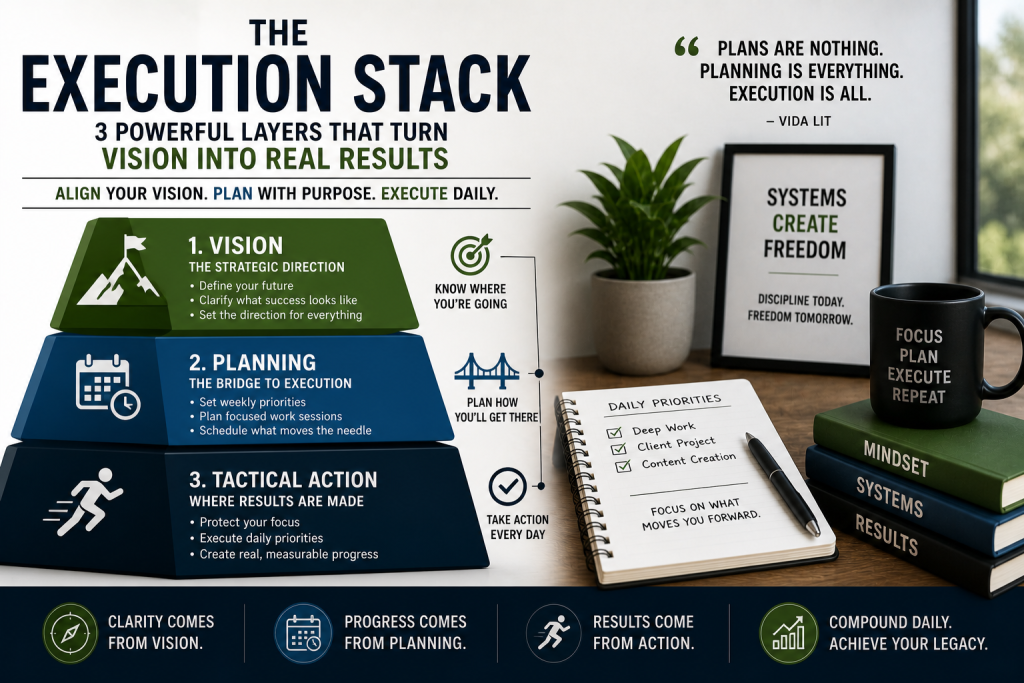
The Execution Stack is the productivity framework that finally answers one of the most frustrating questions high performers face: why does working hard all day still feel like going nowhere?
Most people are not failing because of laziness or lack of effort. They are failing because their daily effort is disconnected from any meaningful long-term direction. Tasks get completed, emails get answered, meetings happen — and at the end of the week, the goals that actually matter have not moved an inch. That is not a work ethic problem. It is a structural problem.
The Execution Stack is a three-layer framework at the core of the Vida Lit Life Operating System. It aligns long-term vision with weekly planning and daily tactical action so that every hour of effort compounds toward something that actually matters. When these three layers work together, productivity stops being reactive and starts being deliberate.
Here is how each layer works — and how to build your own Execution Stack starting this week.
What Is the Execution Stack?
The Execution Stack is a structured productivity framework built around three interdependent layers: Vision, Planning, and Tactical Action. Each layer depends on the one above it and feeds into the one below it.
Without vision, planning has no direction. Without planning, daily action has no priority. Without daily action, vision and planning remain permanently theoretical. The Execution Stack makes sure all three layers are active, aligned, and working together — which is what transforms ambition into consistent, measurable progress.
Research in goal-setting psychology consistently shows that clear, meaningful long-term goals significantly improve both motivation and performance. But goals alone are not enough. The Execution Stack is the bridge between knowing what you want and actually building it.
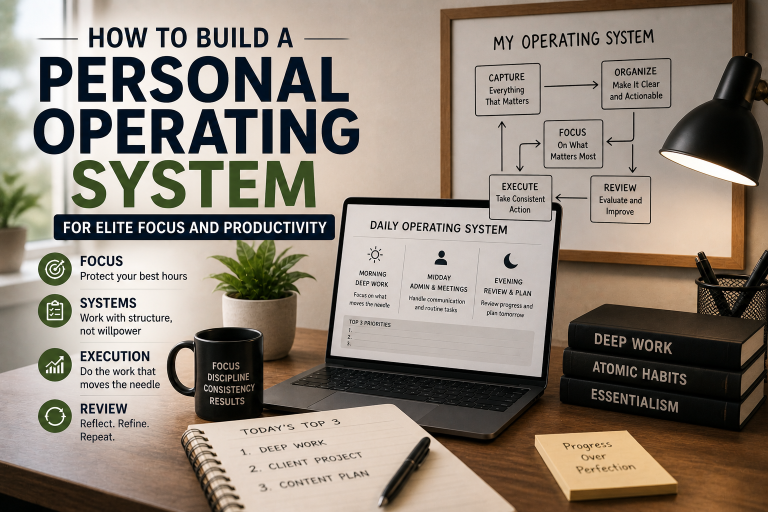
How to Build a Personal Operating System
Layer 1: Vision — The Strategic Direction of Your Execution Stack
Vision sits at the top of the Execution Stack because it defines everything beneath it. It answers the foundational questions that most people never stop to ask clearly:
- What are you actually building?
- What does success look like in three to five years?
- What kind of life, career, or business are you designing?
Without a clear vision at the top of your Execution Stack, daily work defaults to reactive mode. You respond to whatever feels urgent, whatever pressure arrives from outside, or whatever task is sitting in front of you. You stay busy but drift — because busy without direction is just movement, not progress.
Vision changes this by providing context for every decision below it. It tells you which opportunities are worth pursuing and which distractions — however compelling they look in the moment — are simply not aligned with where you are going.
A practical example: an entrepreneur whose vision is building a financially independent, location-independent business will use that vision to filter every decision about skills to develop, projects to prioritize, and time to allocate. Vision is not a motivational poster on the wall. Inside the Execution Stack, it is a functional decision-making filter used every single week.
How to define your vision: Write a clear, specific answer to this question — “What am I building over the next three to five years, and what does success look like when I get there?” Keep it to three to five sentences. Specific beats vague every time.
Layer 2: Planning — The Bridge in Your Execution Stack
Planning is the most underbuilt layer in most people’s Execution Stack. Vision without planning is just a dream. Planning is what converts direction into actionable priorities that can actually be scheduled and executed.
Effective planning inside the Execution Stack happens primarily at the weekly level. Instead of managing a sprawling task list of dozens of items, the focus shifts to identifying a small number of high-impact priorities that directly advance larger goals. Research on productivity and time management consistently shows that focusing on fewer, more meaningful objectives produces better outcomes than attempting to do everything at once.
The weekly planning session — ideally 30 minutes at the same time each week — should answer three questions:
- What are the two or three most important things I need to move forward this week?
- What focused work sessions do I need to schedule to make that happen?
- What from last week is unfinished, and does it still deserve a place in this week’s plan?
This layer is where ambition becomes scheduled. Projects get broken into milestones. Milestones get broken into specific work sessions. Work sessions get blocked on the calendar. Without this layer active in your Execution Stack, your vision stays abstract and your daily effort stays scattered.
Layer 3: Tactical Action — Where the Execution Stack Produces Results
Tactical action is where the Execution Stack delivers. Vision gives you direction. Planning gives you priorities. Tactical action is where results are actually produced — through focused, deliberate, daily work.
At this layer, the primary job is protecting attention and completing meaningful tasks. Long deep work sessions, minimal distractions, and clearly defined daily priorities ensure that effort flows toward the most valuable activities — not just the most visible or urgent ones.
Studies on sustained attention and cognitive performance show that uninterrupted focus is one of the most powerful productivity multipliers available. Research published in Psychological Science found that even brief mental breaks during long tasks significantly improved sustained concentration — suggesting that structured work and rest cycles, not constant grinding, produce the best tactical output.
A practical example of tactical action inside the Execution Stack: someone building expertise in a new field schedules a daily 90-minute deep work session for study, practice, or content creation. Each individual session looks small. But consistent execution compounds over weeks and months — and that compounding is where real momentum becomes visible and measurable.
Three rules for strong tactical action:
- Start with your most important task first — before email, before admin, before anything reactive.
- Protect at least one uninterrupted deep work block every day — this is non-negotiable inside a working Execution Stack.
- End each day by reviewing what you completed and setting tomorrow’s top priority — this keeps the planning layer alive on a daily basis.
How the Three Layers of the Execution Stack Work Together
The power of the Execution Stack is not in any single layer — it is in the alignment between all three.
Vision tells you where you are going. Planning translates that destination into this week’s priorities. Tactical action executes those priorities through focused daily work. Each layer feeds directly into the next, creating a system where effort is never wasted on things that do not matter and progress is always moving in a clear direction.
When one layer breaks down, the whole stack weakens. Vision without planning stays theoretical. Planning without tactical action stays theoretical. Tactical action without vision or planning produces effort that goes nowhere. The Execution Stack only works when all three layers are active and aligned.
This is the philosophy behind the Vida Lit Life Operating System: not just working harder, but building the structure that makes sure hard work actually compounds into something meaningful.
Frequently Asked Questions About the Execution Stack
What is the Execution Stack? The Execution Stack is a three-layer productivity framework developed within the Vida Lit Life Operating System. It aligns long-term vision, weekly planning, and daily tactical action into a single coherent system so that effort consistently compounds toward meaningful goals.
Why do most productivity systems fail? Most productivity systems focus only on tactical action — task lists, time blocking, habit tracking — without connecting daily effort to a clear long-term vision. Without the top two layers of the Execution Stack, even the most disciplined daily routine can produce progress in the wrong direction.
How do I start building my own Execution Stack? Start at the top: write a clear three-to-five year vision in three to five specific sentences. Then run one weekly planning session to identify your top two or three priorities for the week. Finally, block at least one daily deep work session to execute on those priorities. That is your Execution Stack — simple, aligned, and ready to compound.
How often should I review my Execution Stack? The vision layer should be reviewed monthly or quarterly to make sure it still reflects where you want to go. The planning layer runs weekly. The tactical action layer runs daily. Each review keeps the layers aligned and the system working.
Build Your Execution Stack and Start Making Real Progress
Staying busy is easy. Making real, compounding progress toward something that matters is a structure problem — and the Execution Stack is the solution.
When vision, planning, and tactical action are aligned inside your personal productivity system, effort stops feeling scattered and starts feeling purposeful. That is not motivation. That is infrastructure.