How to Create a Focus Environment for ADHD
Learning how to create a focus environment for ADHD is one of the most overlooked yet powerful things you can do for…
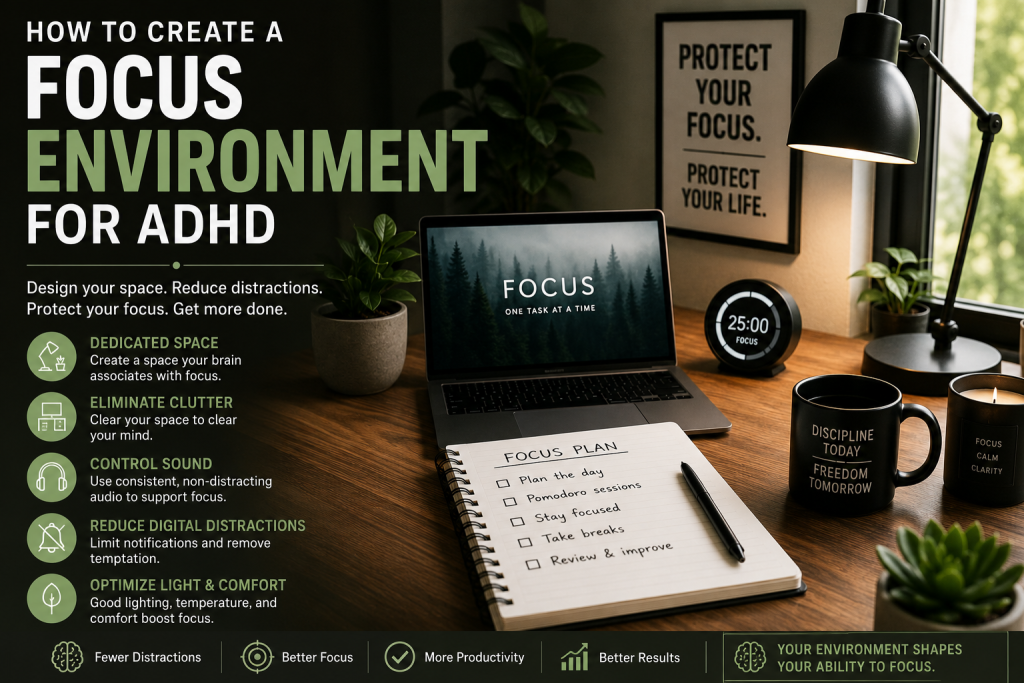
Learning how to create a focus environment for ADHD is one of the most overlooked yet powerful things you can do for your attention.
Your Environment Is Either Working For Your ADHD Brain or Against It
Most productivity advice focuses on what you do.
Work harder. Wake up earlier. Use better systems. Build stronger habits. Try harder to focus.
But for ADHD adults, what you do matters far less than where you do it. Your environment, the physical space, the sensory inputs, the visual landscape, the digital ecosystem surrounding you while you work, has a profound and largely underappreciated influence on your ability to focus.
Here’s why this matters so much for ADHD specifically. Neurotypical brains have a relatively robust filtering system, the ability to automatically tune out irrelevant environmental inputs and direct attention toward what matters. ADHD brains have a significantly weaker version of this filter.
According to ADDitude Magazine, one of the leading ADHD resources online, this reduced ability to filter out sensory and environmental distractions is one of the most consistently reported challenges for adults with ADHD.
Sounds, movements, visual clutter, digital notifications, and environmental novelty that neurotypical people process and dismiss automatically compete actively for ADHD attention, drawing cognitive resources away from the task at hand in a way that feels genuinely involuntary.
This means that for ADHD adults, environmental design is not a nice-to-have productivity upgrade. It is a fundamental prerequisite for focus. Trying to concentrate in a poorly designed environment with ADHD is like trying to have a quiet conversation in a room where someone is playing loud music, technically possible but requiring enormous effort for results that should come naturally.
The good news is that with deliberate design, your environment can be transformed from something that works against your ADHD brain into something that actively supports it. In this guide, we’ll walk through exactly how to do that — step by step, room by room, screen by screen.
Why This Matters Specifically for ADHD
Environmental design for ADHD is different from general workspace optimization because it needs to address the specific neurological vulnerabilities of ADHD brains — not just generic productivity preferences. The strategies in this guide are specifically chosen to reduce the sensory dysregulation, attentional competition, and decision fatigue that make ADHD focus so challenging, creating an environment that does some of the executive function work that ADHD brains struggle to do internally.
How to Create a Focus Environment for ADHD Step by Step
Step 1: Designate a Dedicated Focus Space
The single most powerful environmental intervention for ADHD focus is creating a dedicated space whose sole purpose is focused work. When a specific physical location is used exclusively for focused work and nothing else, your brain begins to associate that location with the focus state, creating a conditioned response that makes entering focus mode faster and easier over time.
This doesn’t require a separate room or home office. A specific desk, a particular corner of a room, or even a specific chair at a coffee shop can serve as a dedicated focus space as long as it’s used consistently and exclusively for focused work rather than for relaxation, social media browsing, or entertainment.
The key principle is consistency. Use your focus space only for focused work. Do your relaxing, scrolling, and entertainment elsewhere. Over weeks your brain will build a neurological association between the physical space and the cognitive state you want to be in when you enter it.
ADHD tip: If you work from home and your workspace is also your living space, create a physical ritual that signals the transition into focus mode when you sit at your desk, putting on headphones, turning on your white noise machine, or placing your focus tools in front of you. The ritual anchors the focus state to the physical space even when the two overlap.
Step 2: Eliminate Visual Clutter From Your Workspace
Visual clutter is a significant and often underestimated source of attentional competition for ADHD brains. Every object in your visual field that isn’t directly related to your current task is a potential distraction, a small but real pull on your attentional resources that adds up across hundreds of items in a cluttered workspace.
The goal of a visually clean ADHD workspace is not aesthetic minimalism for its own sake. It’s cognitive load reduction, removing as many competing visual inputs as possible so that your brain’s limited attentional resources can be directed at the task rather than at processing an environment full of irrelevant visual information.
Start by removing everything from your desk surface that you don’t need for your current work session. Put it in a drawer, a storage box, or out of sight. Out of sight genuinely means out of mind for ADHD brains. Leave only your computer, your notebook, your current task materials, and your focus tools.
ADHD tip: A simple “desk reset” at the end of each workday — clearing your surface to a clean baseline — means you start every morning with a visually calm environment rather than having to deal with yesterday’s visual chaos before you can focus.
Step 3: Control Your Auditory Environment
Sound is one of the most powerful environmental variables for ADHD focus and one of the most controllable. Unpredictable, variable sounds conversations, TV in the background, street noise, coworkers are particularly disruptive for ADHD brains because their novelty and variability constantly trigger the brain’s orienting response, pulling attention away from the task.
The most effective auditory environment for most ADHD adults is not silence, which can actually feel uncomfortably under-stimulating for ADHD brains, but a consistent, non-distracting background sound that provides just enough auditory input to bring the brain to its optimal arousal level without competing for attention.
White noise, brown noise, nature sounds, or instrumental focus music played through noise-canceling headphones creates a controlled auditory environment that masks unpredictable external sounds while providing the steady sensory stimulation that ADHD brains need to focus effectively.
For the best options at every price point, check out our guides on the best noise-canceling headphones for ADHD focus and the best white noise machines for ADHD concentration.
ADHD tip: Use your noise-canceling headphones as a social signal as well as a focus tool. In shared environments, headphones on means focus mode in progress, a visual cue that communicates your unavailability without requiring verbal explanation.
Step 4: Optimize Your Lighting for Alertness and Focus
Lighting has a direct effect on cognitive alertness and circadian rhythm regulation, both of which are particularly relevant for ADHD adults who often struggle with morning grogginess, afternoon energy crashes, and disrupted sleep-wake cycles.
Cool, bright white light in the 5000 to 6500 Kelvin range promotes alertness and cognitive performance during work sessions, mimicking the natural daylight that our brains associate with being awake and active. Warm, dim light promotes relaxation and melatonin production, which is appropriate for evening wind-down but counterproductive for focus sessions.
Position your desk near a window for natural daylight during morning work sessions where possible. Add a daylight-spectrum desk lamp for supplemental lighting during dark mornings or afternoon sessions. And consider a 10,000 lux light therapy lamp during morning work sessions to directly support the circadian rhythm regulation that ADHD brains often struggle to maintain naturally.
ADHD tip: Dim your lights and switch to warm color temperature settings in the evening as a deliberate environmental signal to your brain that the work day is ending and rest time is approaching. This environmental transition supports the wind-down that ADHD brains struggle to initiate on their own.
Step 5: Set Up Your Digital Environment for Focus
Your physical workspace is only half of your focus environment. Your digital environment, the apps, notifications, browser tabs, and digital clutter on your devices, is equally important and for many ADHD adults, even more impactful because it’s where the most compelling distractions live.
A focus-optimized digital environment starts with notification management. Turn off all non-essential notifications on your phone and computer during focus sessions. Every notification is an interruption that takes ADHD brains significantly longer to recover from than neurotypical ones. Studies suggest it takes an average of 23 minutes to regain focus after an interruption. For ADHD brains, this recovery time can be even longer.
Install a distraction-blocking app like Freedom that prevents access to distracting websites and apps during focus sessions. Clear your browser of unnecessary open tabs before starting work. Each open tab is a visual reminder of something else you could be doing instead of the task at hand.
ADHD tip: Create a dedicated focus profile on your computer a separate browser profile or user account with only work-related bookmarks and apps, and no social media access. Switching to your focus profile creates a digital environment transition that mirrors the physical space transition of sitting at your dedicated focus desk.
Step 6: Use Scent as an Environmental Focus Anchor
Scent is one of the most underutilized environmental focus tools for ADHD adults and one of the most powerful. The olfactory system has a uniquely direct connection to the brain’s limbic system, which regulates arousal, emotion, and memory. Certain scents can trigger specific neurological states with remarkable speed and consistency.
Rosemary and peppermint have the strongest research support for cognitive alertness and focus enhancement. Diffusing these scents consistently during work sessions creates a sensory anchor your brain learns to associate the scent with focus mode, making the transition into concentration faster and more automatic over time.
Use an ultrasonic diffuser on your desk with your chosen focus blend running from the start of your first focus session each day. Rotate between different focus scents periodically to prevent habituation ADHD brains adapt quickly to consistent sensory input and the effectiveness of a single scent can diminish over time.
ADHD tip: Use a different scent for your evening wind-down, lavender or cedarwood, than you use for your focus sessions. This sensory differentiation reinforces the transition between work mode and rest mode, helping your ADHD brain shift states more effectively.
Step 7: Add Movement Options to Your Workspace
ADHD brains need movement to function at their best, and a focus environment that forces complete stillness is working against the neurological reality of ADHD. Building movement options into your workspace gives your brain the physical stimulation it needs without requiring you to leave your work environment.
A standing desk is the most impactful addition to any ADHD workspace. The ability to alternate between sitting and standing throughout the day provides continuous low-level physical engagement that supports dopamine regulation and reduces the restlessness that makes prolonged sitting so difficult for ADHD adults.
Complement your standing desk with an anti-fatigue mat that has surface texture variations for subtle foot movement, a balance or wobble board for additional proprioceptive stimulation during standing sessions, and a selection of desk fidget tools that give your hands a quiet outlet for restless energy during seated focus sessions.
ADHD tip: Set a recurring reminder every 25 to 30 minutes to change position from sitting to standing or vice versa. ADHD hyperfocus means you’ll forget to change positions without an external prompt, and remaining in one position too long is one of the fastest routes to restlessness and focus deterioration.
Step 8: Manage Temperature for Optimal Cognitive Performance
Room temperature has a measurable effect on cognitive performance. Research suggests that slightly cool temperatures in the range of 68 to 72 degrees Fahrenheit promote better focus and cognitive accuracy than warmer environments. Excessive warmth promotes drowsiness and reduces alertness particularly problematic for ADHD adults who already struggle with maintaining sufficient arousal for focus.
Keep your focus space on the cooler side of comfortable during work sessions. If you work in a space where you can’t control the temperature, such as a shared office or a warm apartment in summer, a small personal fan directed at your workspace can simulate the alertness-promoting effect of cooler temperatures.
ADHD tip: If you find yourself getting sleepy or losing focus during afternoon sessions, lowering the room temperature or directing a fan at yourself is one of the fastest physical interventions for restoring alertness, more immediate in effect than caffeine and without the anxiety side effects.
Step 9: Create Clear Transitions Between Focus and Rest Modes
One of the most overlooked aspects of focus environment design for ADHD is the transition protocol, the ritual that marks the beginning and end of focused work periods. Without clear transitions, ADHD brains struggle to shift between states, spending the first part of a work session still mentally in rest mode and the last part unable to disengage from work mode when it’s time to stop.
A focus start ritual might include: clearing your desk, putting on your headphones, turning on your diffuser, opening only the tabs you need, starting your timer, and writing your single focus task at the top of your notepad. This sequence of actions done in the same order every time trains your brain to associate the ritual with focus mode, making the state transition faster and more reliable over time.
An equally important focus and ritual might include: completing your capture list review, writing tomorrow’s top three tasks, closing all work tabs, turning off your diffuser, and removing your headphones. The end ritual creates the closure that ADHD brains need to genuinely transition out of work mode.
ADHD tip: Your focus start ritual should take no more than three to five minutes. If it becomes too elaborate, it turns into procrastination. Keep it short, consistent, and focused on the specific environmental adjustments that make the biggest difference to your focus state.
Step 10: Iterate and Personalize Your Environment Over Time
No focus environment is perfect from day one and the most effective ADHD focus environment is one that evolves based on what you learn about your specific brain’s needs through experience.
Pay attention to which environmental factors consistently correlate with your best focus sessions and which ones tend to precede your most distracted ones. Is your focus better in the morning or afternoon? With music or with white noise? With or without the diffuser? Sitting or standing? These patterns are personal they reflect your individual neurological profile rather than universal ADHD characteristics.
Keep a brief weekly note of your focus observations, what worked, what didn’t, and what you want to adjust. Treat your focus environment as an ongoing experiment rather than a fixed setup. The ADHD adults who build the most effective focus environments are the ones who stay curious about their own brain and keep refining their environment based on what they discover.
Common Mistakes to Avoid
Trying to optimize everything at once. Adding a standing desk, a diffuser, noise-canceling headphones, a light therapy lamp, and a complete desk declutter simultaneously is overwhelming and makes it impossible to know what’s actually helping. Add one environmental element at a time and evaluate its impact before adding the next.
Neglecting your digital environment. Many ADHD adults focus all their environmental design effort on the physical workspace while leaving their digital environment as chaotic as ever. Notification overload and unrestricted internet access will undermine even the most perfectly designed physical workspace.
Treating your focus space as a multi-purpose space. Eating, social media browsing, watching TV, and doing focused work in the same physical space prevents the neurological association between space and focus state from forming. Protect your focus space’s single-purpose identity.
Forgetting to maintain the environment. The best focus environment design collapses without maintenance. Visual clutter accumulates, supplies run out, equipment goes uncharged. A brief daily desk reset and weekly environment review keeps your focus environment consistently effective.
Designing for others rather than for your brain. Your focus environment should be optimized for your specific ADHD brain, not for what looks most impressive on Instagram or what a neurotypical productivity guru recommends. If brown noise works better for you than white noise, use it. If a slightly messy desk doesn’t bother your focus but a cluttered digital desktop does, prioritize the digital cleanup. Know your brain and design for it.
Frequently Asked Questions
What is the best environment for ADHD focus? The best focus environment for ADHD is one that minimizes unpredictable sensory inputs, particularly sound and visual clutter, provides consistent low-level stimulation through white noise or focus music, incorporates movement options like a standing desk, and has clear digital boundaries through notification management and distraction blocking. The specific optimal environment varies by individual.
Does a clean desk really help with ADHD? Yes — research on cognitive load suggests that visual clutter in the environment competes for attentional resources and impairs cognitive performance. For ADHD adults whose attentional systems are already taxed, reducing visual clutter can produce meaningful improvements in focus quality and mental clarity.
Can I focus with ADHD in a noisy environment? Some ADHD adults focus better with moderate background noise like coffee shop ambient sound than in complete silence. However, most find that unpredictable variable noise, such as conversations, TV, and street noise, is too distracting for sustained focus. The key is controlled, consistent sound through headphones rather than environmental noise you can’t manage.
How do I create a focus environment in a shared space? In shared spaces, the most effective strategies are noise-canceling headphones to control your auditory environment, a desk partition or positioned monitor that limits visual distraction, clear communication about your focus time with others in the space, and distraction blocking apps to manage your digital environment when you can’t control the physical one.
Does working from cafes help ADHD focus? For many ADHD adults, cafes provide a helpful body doubling effect; the presence of other working people increases neurological arousal in a way that supports focus. However, the variable noise and visual stimulation of a busy cafe can be too distracting for deep focused work. Cafes often work better for lower-demand tasks and physical desk setups work better for deep cognitive work.
Final Thoughts: Design Your Environment and Let It Do the Work
The most sustainable ADHD focus strategy is not trying harder every day. It’s building an environment that makes focus easier so that the cognitive work of concentration is supported by your surroundings rather than undermined by them.
Start with the highest-impact changes first. Clear your desk. Put your phone in another room. Install a website blocker. Put on noise-canceling headphones with white noise. These four changes alone will transform your focus environment more than any willpower-based strategy.
Then build from there the standing desk, the light therapy lamp, the diffuser, the dedicated focus rituals layer by layer, adjustment by adjustment, until your workspace is genuinely designed for your ADHD brain.
Continue Your Growth
- Best Noise-Canceling Headphones for ADHD Focus
- Best Standing Desks for ADHD Focus and Movement
- Best Light Therapy Lamps for ADHD Morning Focus
- How to Stop Procrastinating with ADHD at Work
- How to Build a Time Management System for ADHD
Your environment is one of the most powerful productivity tools you have. Design it intentionally and let it do the heavy lifting.