How to Manage Time with ADHD as a Busy Professional (Without Burning Out)
If you have ADHD, time doesn’t work the way other people say it does. You sit down to answer one email and…

If you have ADHD, time doesn’t work the way other people say it does.
You sit down to answer one email and suddenly it’s 3 hours later, the email still isn’t sent, and you’ve somehow redesigned your entire filing system. Or the opposite — you go completely blank, stare at your task list, and can’t figure out where to even begin. Neither version feels like a productivity problem. It feels like a you problem.
It isn’t.
To me, my brain feels like pushing on the gas pedal while also pressing on the brakes at the same time. Everything is running, but nothing is moving forward.
ADHD fundamentally changes how your brain perceives, tracks, and manages time. Researchers call it time blindness — the genuine neurological difficulty in sensing how much time has passed or how long something will take. For busy professionals juggling deadlines, meetings, and responsibilities, this isn’t just frustrating. It’s career-threatening.
The good news? You don’t need to force yourself into a neurotypical productivity system that was never built for your brain. You need strategies specifically designed for how your brain actually works. That’s exactly what this guide gives you.
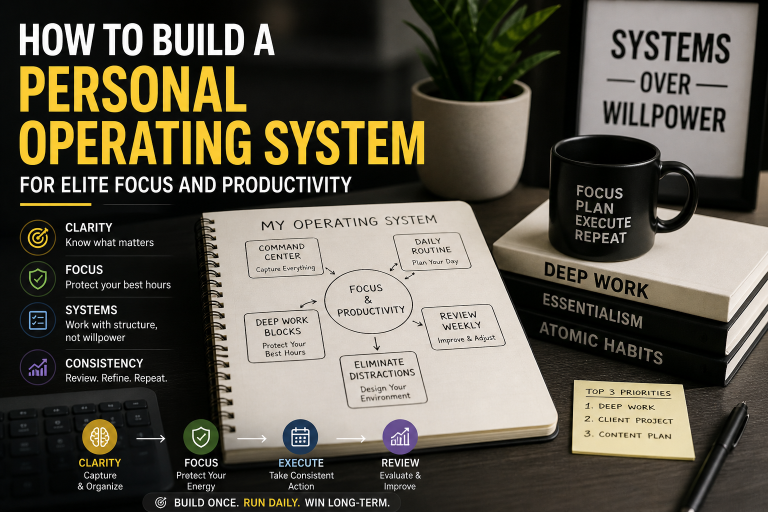
And if you want to go even deeper, our guide on how to build a personal operating system for deep focus shows you how to put all these strategies together into one complete system built around your ADHD brain.
Why Time Management Is So Hard With ADHD
Most time management advice assumes you can simply decide to focus, set a timer, and execute. For people with ADHD, that advice ignores the entire problem.
ADHD affects your executive function — the mental system responsible for planning, prioritizing, initiating tasks, and tracking time. When that system is dysregulated, the result isn’t laziness or poor character. It’s a brain that genuinely struggles to connect “what I need to do” with “when I need to do it” and “how long it will take.”
According to ADDitude Magazine — one of the leading ADHD resources online — time blindness is one of the most commonly reported and practically addressable challenges for adults with ADHD in the workplace.
Busy professionals with ADHD often experience:
- Task paralysis — knowing you have work to do but being unable to start
- Hyperfocus traps — diving so deep into one thing that everything else gets ignored
- Chronic underestimating — believing tasks will take 20 minutes when they take 2 hours
- Transition difficulty — struggling to switch from one task to another
- The 5-minute illusion — “I’ll just do this quickly” turning into an hour lost
Understanding why time management is genuinely hard for your brain is the first step to building systems that actually help. Here are 9 strategies that work specifically for ADHD brains.
How to Manage Time with ADHD: 9 Strategies That Actually Work
1. Make Time Visible Everywhere
The single most impactful change most people with ADHD can make is turning time from an abstract concept into something they can actually see.
Digital clocks on your phone don’t cut it. You glance, your brain logs a number, and 40 minutes later you’re shocked it’s gone. What works better is a visual timer you can see at all times — one where the countdown gives your brain a concrete cue that time is literally passing.
The best thing that has worked for me during desk and knowledge work is having a timer running on my laptop at all times. An ADHD brain needs to see time running. For us, everything is about building urgency — and a visual timer creates exactly that.
But here is the real truth — we have to accept that everything we do is either for us or against us. We will always look for reasons to procrastinate. Which is why the timer needs to be on your laptop screen — not a physical object you can ignore.
Download any app to track time. Do not get distracted by metrics and features. That is just another excuse to add more to your plate and avoid the work. Set the time and start.
I personally use Be Focused.
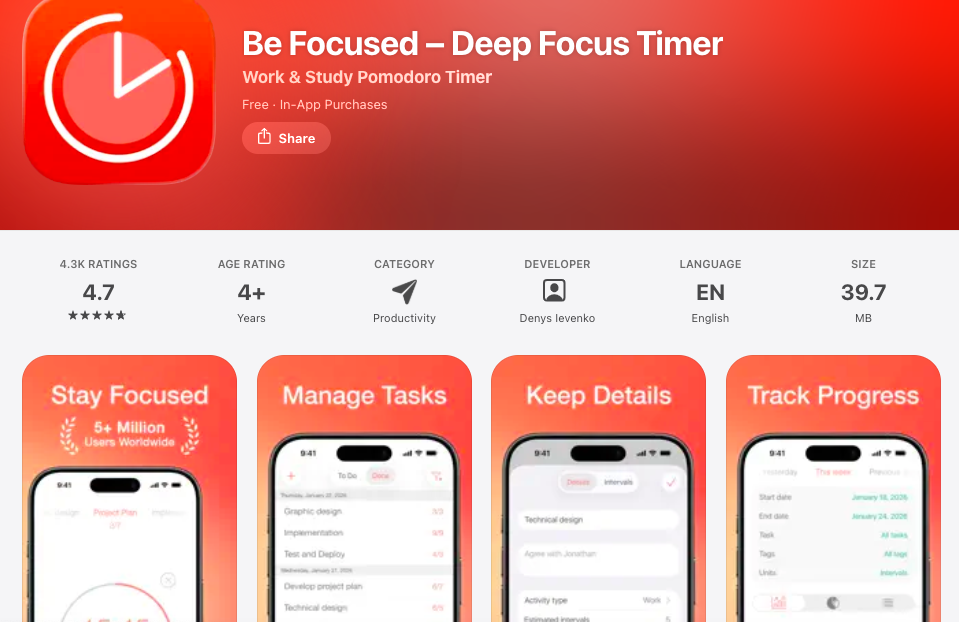
I have it set to four 30-minute intervals. I had to work up to it — but now I can go a very long time without losing focus. I rarely do more than two hours even when I am in flow. I would advise you do the same. ADHD hyperfocus can feel productive but it is often just our brain procrastinating on everything else. We have to learn to control it.
For a full breakdown of the best timer apps available check out our guide on the best time blocking apps for ADHD professionals.
2. Use Time Blocking — But Build in Buffer Zones
Time blocking means scheduling specific tasks into specific windows of your day rather than working from an open to-do list. For people with ADHD, a list without time anchors is practically invisible — the tasks just sit there competing for your attention with zero context for when to act on them.
The key is to block time AND build in transition buffers between every block.
If a meeting ends at 2:00 PM don’t schedule your next task at 2:00 PM. Schedule it at 2:20 PM. That 20 minutes isn’t wasted — it’s the time your ADHD brain needs to decompress, physically move, reset, and arrive at the next task with some mental bandwidth still available.
For more on protecting your focus blocks read our guide on how to reduce distractions for ADHD professionals.
A great tool for visual time blocking is Sunsama. It integrates your tasks, calendar, and daily planning into one clean daily view — and it is specifically popular among professionals with ADHD for making the shape of a full workday visible rather than abstract and overwhelming.
3. Work With Your Energy — Not Against It
ADHD brains are not consistently available for all tasks at all times. You likely have a peak window — maybe 60 to 90 minutes — where your focus is genuinely at its sharpest. If you waste that window on low-effort admin work you have burned your best cognitive fuel on the wrong task.
Start tracking when you feel most focused during the day. For most people it is mid-morning. Guard that window fiercely. Put your hardest highest-stakes work there — the task that requires the most mental effort. Save email, meetings, and routine admin for your lower energy periods.
Understanding how dopamine drives your focus and motivation helps explain exactly why matching your hardest work to your peak energy window makes such a dramatic difference for ADHD brains.
A great way to track your energy patterns over time is with the Oura Ring. It monitors your sleep quality, readiness score, and daily energy levels — giving you real objective data on when your brain is actually primed to perform. For ADHD adults who struggle with self-awareness around energy levels, having concrete numbers removes the guesswork entirely.
This sounds simple. It is simple. It’s also one of the most ignored time management principles for ADHD professionals because it requires a little upfront self-awareness. The payoff is enormous.
4. Use External Accountability to Start Tasks
Initiation — the act of starting — is often where ADHD time management breaks down completely. You know you need to start. You want to start. You just can’t. This isn’t laziness. It is a real deficit in self-activation that is part of ADHD’s neurological profile.
External accountability provides the activation energy your brain cannot generate alone. Your options include:
- Body doubling — working in the physical or virtual presence of another person. Focusmate matches you with an accountability partner for virtual co-working sessions. Many people with ADHD describe this as a complete game changer.
- Commitment devices — telling a colleague or manager you will have something done by a specific time creates urgency your brain can respond to.
- Coworking spaces or coffee shops — the low-level social pressure of working around other people activates ADHD brains in a way that working alone at home never does.
The goal is to borrow the motivational structure your brain needs from your environment rather than from internal willpower that ADHD makes unreliable. For more on this read our guide on building a discipline system that works without motivation.
5. Apply the Two-Minute Rule — Modified for ADHD
The classic two-minute rule says: if something takes less than two minutes, do it now. For ADHD this rule needs one important modification — only apply it when you are already in a low-focus mode.
If you are in deep work do not stop to respond to a quick message. That two-minute interruption costs you up to 23 minutes of refocus time. Instead keep a running quick-tasks list nearby. When you hit a natural break — between blocks, before lunch, after a meeting — run through the whole list at once.
For capturing quick tasks fast without breaking your flow a dedicated capture tool beats a sticky note every time. The Rocketbook Smart Reusable Notebook lets you jot tasks by hand — which engages your brain differently than typing — then scan pages directly to your digital apps like Notion or Google Drive. It is reusable, portable, and keeps your quick-task list physical and visible rather than buried in another app.
This batching approach protects your focus windows while still keeping small tasks from piling up into an overwhelming backlog.
6. Use Timers as a Commitment Tool
A timer does more than track time — it creates a psychological contract with yourself.
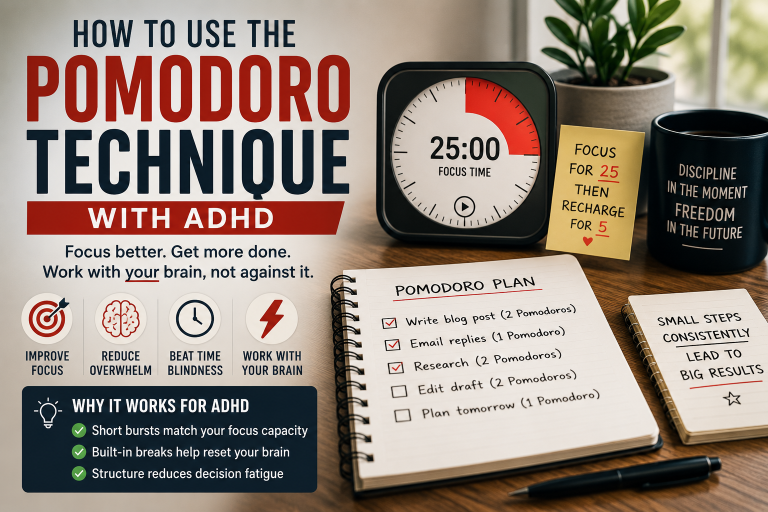
The Pomodoro Technique — 25 minutes of work followed by a 5-minute break — is widely recommended for ADHD but it is not one size fits all. Some ADHD brains need longer blocks of 45 to 90 minutes to reach a genuine flow state before breaking. Others do better with 15-minute sprints.
The important thing is not the exact duration — it is the structure the timer creates. It answers the question your ADHD brain keeps asking: how long do I have to do this?
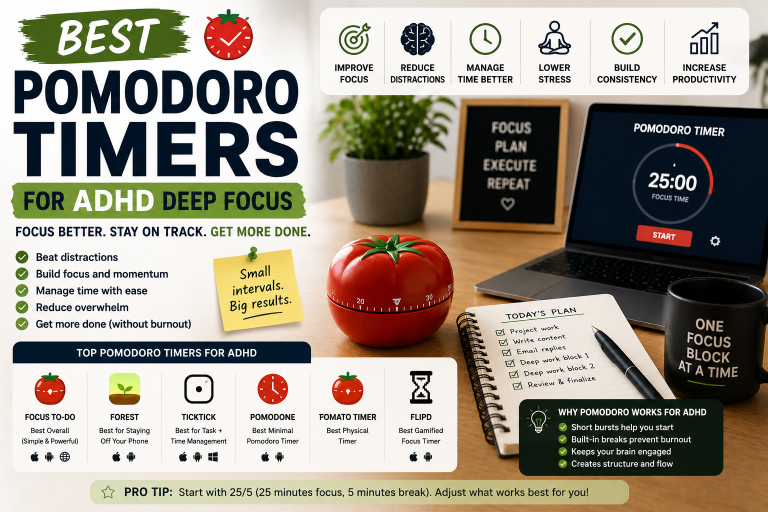
A physical timer works better than a phone timer for most ADHD adults because it keeps the countdown visible and eliminates your phone as a distraction trigger. The Time Timer PLUS is a durable desk-friendly option that many ADHD professionals swear by. For a full breakdown of the best timer options check out our guide on the best timers for ADHD time management at work.
7. Build a Shutdown Ritual to End Your Workday
One of the most underrated ADHD time management strategies is having a clear consistent end-of-day routine that signals to your brain that work is over.
Without a shutdown ritual work bleeds indefinitely into personal time — not because you are productive but because the ADHD brain struggles to transition and often loops back to unfinished business late into the night.
A simple shutdown ritual might look like this:
- Review what you completed today — 2 minutes
- Write tomorrow’s top 3 priorities — 3 minutes
- Close all browser tabs and applications
- Say out loud — “Shutdown complete” — yes, out loud, it genuinely works
This routine creates a mental full stop that tells your nervous system the day is done and you can actually rest.
A dedicated paper planner makes steps 1 and 2 faster and more satisfying than any app. The Full Focus Planner by Michael Hyatt is one of the most ADHD-friendly planners available — structured around daily priorities and a built-in shutdown sequence rather than endless to-do lists. Having a physical object you close at the end of the day adds a tactile finality that screens simply cannot replicate.
8. Reduce Decision Fatigue With Templates and Defaults
Every decision you make during the day costs mental energy. For people with ADHD who often start the day with a smaller reservoir of executive function, unnecessary decisions are expensive. Reduce them by creating defaults:
- Weekly schedule templates — a default version of your ideal week that you adjust rather than rebuild from scratch each Monday
- Email templates for your most common responses
- Meeting agendas you reuse and tweak rather than create from scratch every time
- A morning startup routine that is identical every day so you never have to decide how to begin
Notion is an excellent tool for building and storing all of these templates in one accessible place. It is flexible enough to match how ADHD brains work — non-linear, visual, and completely customizable to your specific needs.
9. Review and Adjust Weekly — Not Just Daily
Most productivity systems focus exclusively on daily planning. For ADHD the weekly review is where the real magic happens. Once a week — Friday afternoon or Sunday evening works well — spend 20 to 30 minutes asking yourself these four questions:
- What worked this week?
- What kept getting pushed off — and why?
- Where did I lose the most time?
- What does next week actually look like?
A structured weekly planner makes this review faster and more consistent. The Panda Planner Pro is designed around exactly this kind of weekly reflection — with dedicated sections for wins, priorities, and habit tracking that work particularly well for ADHD brains who need guided prompts rather than blank pages.
This weekly check-in builds self-awareness over time. You start noticing patterns — the meetings that consistently wreck your afternoon, the tasks you chronically underestimate, the days where you are sharpest. That data becomes the raw material for a time management system tailored specifically to your brain.
Common Mistakes to Avoid
1. Trying to use neurotypical productivity systems without modification. Systems like GTD or standard corporate time management frameworks were built for brains without ADHD. They can work — but they need to be significantly adapted. If a system feels like you are constantly fighting it, the system is wrong. Not you.
2. Relying solely on willpower and motivation. Motivation is unreliable for ADHD brains. Structure, accountability, and environmental design are far more dependable. Build those first and let motivation follow.
3. Scheduling every minute of your day. An overpacked schedule with no buffer collapses the moment one thing runs long — and with ADHD, something always runs long. Leave at least 30 percent of your day unscheduled.
4. Ignoring physical factors. Sleep deprivation, hunger, and poor hydration dramatically worsen every ADHD symptom. Time management strategies work significantly better when your basic physiology is managed. This is not optional. It is foundational.
5. Quitting the system after one bad day. Every system fails sometimes. An ADHD-friendly system is not one that is perfect — it is one that is easy to restart after it falls apart. Build your systems with that expectation from the very beginning.
Frequently Asked Questions
Why is time management so hard with ADHD specifically? ADHD affects executive function and time perception — the neurological systems responsible for tracking time, estimating duration, initiating tasks, and planning ahead. According to ADDitude Magazine this is called time blindness and it is a genuine neurological challenge — not a character flaw or a discipline problem.
What is the best time management tool for ADHD? There is no single best tool because ADHD presents differently for everyone. However visual timers like the Time Timer, body doubling apps like Focusmate, and daily planning tools like Sunsama consistently receive the strongest reviews from ADHD users. Start with one tool, use it consistently for two weeks, and evaluate honestly before adding anything else.
Can people with ADHD be good at managing time? Absolutely. Many high-performing professionals have ADHD. The difference is that effective time management for ADHD requires intentional ADHD-specific strategies — not simply harder effort with the wrong tools.
How do I stop underestimating how long tasks take? Start tracking your actual task time using a simple log. Most people with ADHD discover they are off by 2 to 3 times on most estimates. Once you see the pattern you can start building more realistic buffers into your schedule. The Pomodoro Technique also helps because it forces you to measure time in concrete chunks rather than abstract estimates.
Is medication enough to fix ADHD time management? Medication can significantly reduce symptoms and make strategies easier to implement — but it does not automatically install time management skills. Behavioral strategies and environmental design are still essential. Medication and skills work best together not as substitutes for each other.
Final Thoughts
Learning how to manage time with ADHD is not about fixing yourself. It is about building an environment and a system that works with your brain instead of demanding it work like a brain it simply is not.
Start small. Pick one or two strategies from this list — make time visible, add body doubling, or try a weekly review — and implement them consistently before adding more. Overwhelm is the enemy of progress for ADHD brains.
And remember — the goal is not a perfectly optimized schedule. It is a life where you actually have time for the things that matter without the constant dread of dropping the ball.
Vida Lit has a full library of content built specifically for professionals navigating ADHD, productivity challenges, and building the discipline to reach ambitious goals. Start with our guide on building a discipline system that works without motivation and our breakdown of how dopamine affects your focus and productivity — both are essential reading for busy professionals with ADHD who are serious about taking back control of their time.
Ready to take control of your time? Start with one strategy today — not tomorrow, not Monday. Pick the one that resonated most and put it in your calendar right now. That is how real change actually starts.