How to Be Disciplined and Achieve More (Without Relying on Motivation)
If you have ever wondered how to be disciplined without relying on motivation, you are not alone. Most people think disciplined people…
If you have ever wondered how to be disciplined without relying on motivation, you are not alone.
Most people think disciplined people have more willpower.
I don’t think that’s true.
I’ve met incredibly successful people who weren’t particularly motivated or naturally productive.
What they had was systems.
And that’s when I realized something:
Discipline isn’t about forcing yourself to do hard things every day. Although hard times will come, that is where the real learning and growth happen. View it as an opportunity.
It’s about making good decisions once and building an environment that makes those decisions easier to follow.
That’s a much more useful definition.
Because if discipline depends on motivation, you’re in trouble.
Motivation comes and goes.
Discipline is what remains when motivation leaves.
The Problem With Motivation
For years, I waited until I “felt like it.”
I would wait until I felt motivated to:
- Work out
- Build a side business
- Read
- Improve my finances
- Work toward bigger goals
The problem?
Those feelings rarely showed up when I needed them.
And even when they did, they never lasted very long.
Motivation is a great spark.
But it’s a terrible fuel source.
If you want to achieve more, you need something more reliable.
Discipline Is Reducing Friction
One of the biggest lessons I’ve learned is that discipline becomes easier when you remove unnecessary decisions.
For example:
I don’t decide whether I’ll work on improving my life today.
Years ago, I made a rule:
Every day, I spend at least 30 minutes on knowledge work.
That might mean:
- Reading
- Writing
- Budgeting
- Building Vida Lit
- Learning a new skill
The specific activity changes.
The rule doesn’t.
The decision has already been made.
That’s what discipline looks like in real life. If you want to go deeper on how to build this kind of system check out the art of making one time life changing decisions — it is the practical foundation underneath everything discipline requires.
Make Things Easier, Not Harder
Most people try to become disciplined by making life harder.
They create complicated routines.
Extreme workout plans.
Strict diets.
Massive goals.
Then they wonder why they quit.
The better approach is to lower the barrier to action.
Want to exercise?
Start with 10 minutes.
Want to read more?
Read one page.
Want to build a side hustle?
Work on it for 30 minutes.
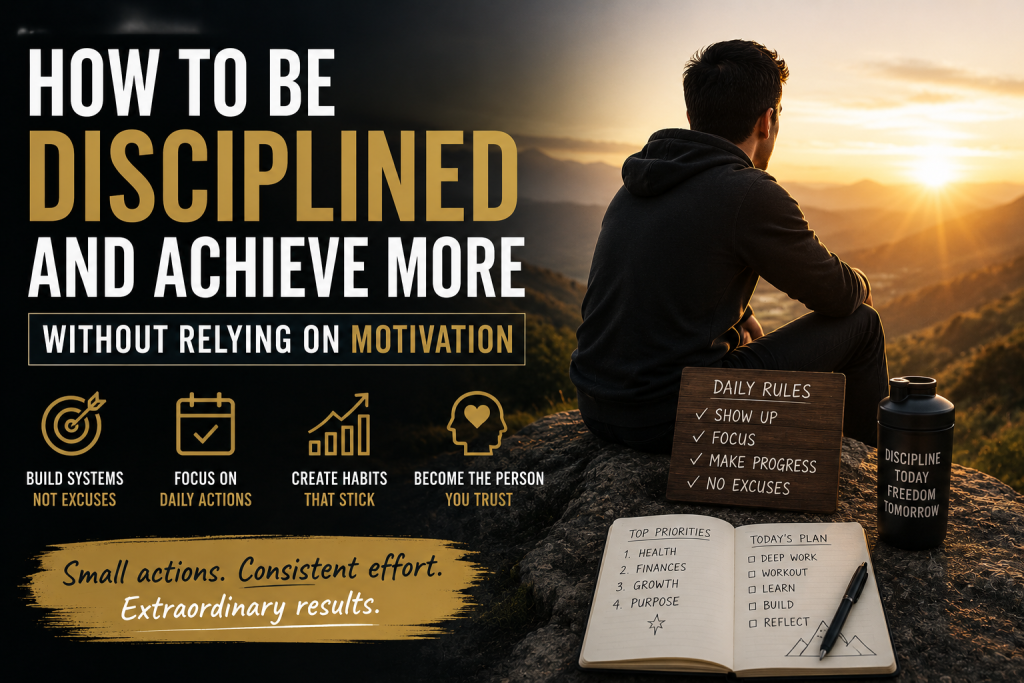
Consistency beats intensity almost every time.
This is also the core principle behind how dopamine drives your focus and motivation — understanding your brain’s reward system makes building consistent habits significantly easier.
Small actions repeated for years create extraordinary results.
Build Habits Instead of Chasing Discipline
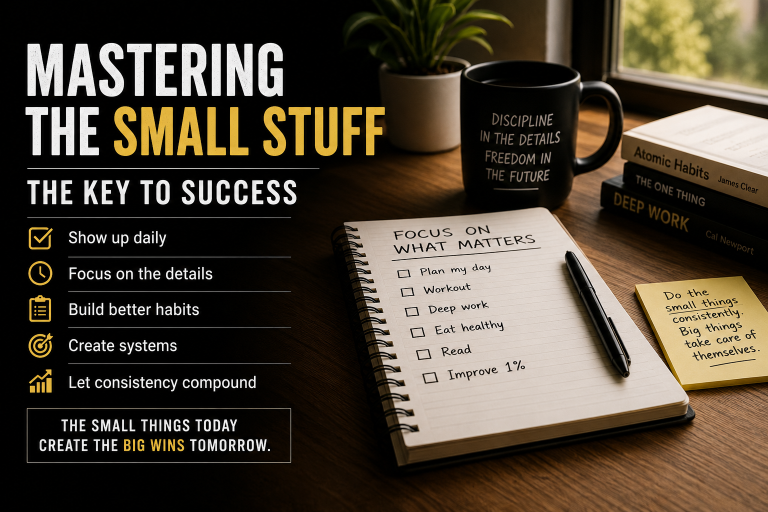
This may sound strange, but my goal isn’t to become more disciplined.
My goal is to need less discipline.
The best habits eventually become automatic.
You stop negotiating with yourself.
You stop debating.
You simply do the thing because that’s what you do.
For example:
I don’t wake up and decide whether I’m going to brush my teeth.
I just do it.
That’s what happens when a behavior becomes part of your identity.
The same thing can happen with:
- Working out
- Reading
- Saving money
- Writing
- Building a business
The goal is to automate success.
Focus on What Matters
One of the biggest reasons people struggle with discipline is that they’re trying to do too much.
Too many goals.
Too many habits.
Too many priorities.
When everything is important, nothing is important.
Instead, identify the few things that would have the biggest impact on your life.
Focus there.
For me, those areas are:
- Health
- Finances
- Relationships
- Personal growth
- Building Vida Lit
Almost every meaningful decision I make falls into one of those categories.
What to Do on the Days You Want to Quit
They will come.
Not once. Regularly.
The days where the workout feels impossible, the business feels pointless, and the book might as well be written in another language.
Most people treat those days as a character problem.
They are not.
They are a planning problem.
On a good day, your normal routine is fine. On a bad day, you need a smaller version of it — decided in advance, while you were thinking clearly.
I call it the minimum version.
Can’t do 30 minutes of knowledge work? Do 5.
Can’t face the full workout? Walk for 10 minutes.
Can’t write the whole page? Write one paragraph.
The minimum version is not about the results of that day. Five minutes changes almost nothing by itself.
It is about protecting the chain.
Because the real damage is never the one small day. The real damage is the story you start telling yourself after you skip completely: “See? I knew I couldn’t stick to this.”
A minimum day keeps the promise alive.
It says: I am still the kind of person who shows up.
Decide your minimum versions now, for every habit that matters to you. Write them down. On the hard days, you will not feel like deciding — and you will not have to.
The decision will already be made.
Discipline Comes From Keeping Promises to Yourself
At its core, discipline is trust.
Every time you follow through on something you said you would do, you strengthen that trust.
Every time you quit, delay, or avoid it, you weaken it.
The good news is that trust can be rebuilt.
One promise at a time. Even a small one.
1 push-up a day for life. 5 minutes of working out every day for life. Read one paragraph of a book for life.
You decide. It’ll get so easy that you’ll find yourself doing more with no effort. And you can always go back and reset where you started because you already decided/made it a rule for the rest of your life.
A life rule to be healthy, to learn, and to grow.
One action at a time.
One day at a time.
You don’t need to become a completely different person overnight.
You just need to become slightly more consistent than you were yesterday.
A Simple 7-Day Start
If all of this feels like a lot, ignore most of it.
Start with seven days.
Day 1: Pick one area. Just one. Health, money, learning, your business — whichever one bothers you the most when you think about it at night.
Day 2: Choose the smallest daily action that moves it. Smaller than you think it should be. One page. Five minutes. One dollar into savings.
Day 3: Decide when it happens. Attach it to something you already do — after coffee, after lunch, right after you walk in the door. A habit without a time is just a wish.
Day 4: Prepare the environment. Shoes by the door. Book on the pillow. App deleted. Make the right thing the easy thing.
Day 5: Do the minimum version on purpose, even if you feel good. You are not training the habit yet. You are training the fallback.
Day 6: Tell someone. Not for applause — for weight. A promise you say out loud is harder to quietly break.
Day 7: Review. Not with judgment, with curiosity. What made it easy? What got in the way? Adjust the system, not yourself.
Then repeat the week.
That is it. No dramatic overhaul. No new personality required.
Seven days of keeping one small promise will teach you more about discipline than a year of waiting to feel motivated.
Take Action
Think about one area of your life where you want better results.
Now ask yourself:
What’s the smallest action I could repeat consistently for the next year?
Not the most impressive action.
The most sustainable action.
Start there.
Then let time do the heavy lifting.
Final Thoughts
Most people spend their lives searching for motivation.
I’ve found it’s much more effective to build systems that work whether you’re motivated or not.
Discipline isn’t about being perfect.
It’s not about never missing a day.
And it’s definitely not about forcing yourself to suffer. Yes, some of us need to hit rock bottom, and that’s when we finally learn. Or we commit to really tough goals, like signing up for a marathon. These things will help, and we at times really do need a wake-up call to finally take control. Trust me, I’m talking from experience.
As Mike Tyson once said, Everybody has a plan until they get punched in the mouth.
Which eventually leads us to here. Where we decide to wake up, to no longer struggle, to take control, to make better decisions, and to make life easier.
By the way, who told you life had to be a struggle?
It’s about creating a life where doing the right thing becomes easier than avoiding it.
Because when that happens, progress stops feeling like a struggle.
It simply becomes part of who you are.