How to Improve Focus Without ADHD Medication — 10 Strategies That Actually Work
Medical Disclaimer: This article is for informational purposes only and is not medical advice. Always consult your doctor or licensed healthcare provider…
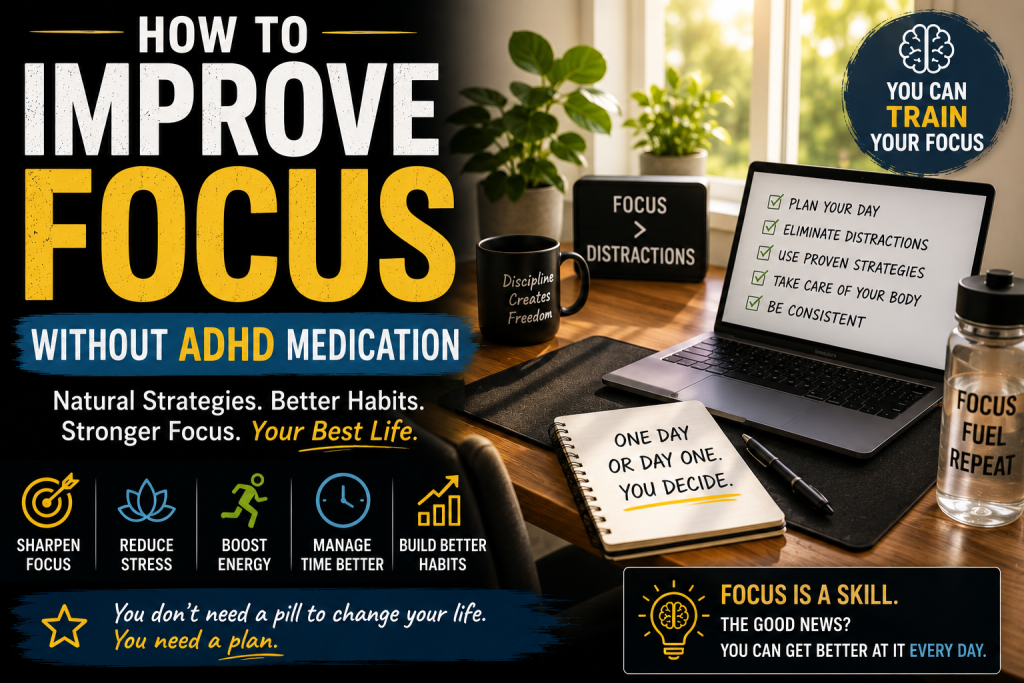
Medical Disclaimer: This article is for informational purposes only and is not medical advice. Always consult your doctor or licensed healthcare provider before making any changes to your ADHD treatment plan, including stopping or reducing medication.
Learning how to improve focus without ADHD medication is not about replacing professional treatment. It is about building the neurochemical and environmental conditions that make your brain work better every single day.
You Can Improve Your ADHD Focus Without Medication — Here’s How
Let’s start with something important.
This article is not anti-medication. Prescription ADHD medication is a legitimate, evidence-based treatment that meaningfully improves quality of life for millions of adults. If you take medication for your ADHD and it works for you, that is a completely valid and smart choice.
But there are many reasons why an ADHD adult might want to improve their focus without relying solely on medication. Maybe you’re waiting for a diagnosis or prescription. Maybe medication doesn’t work well for you or causes side effects you can’t tolerate. Maybe you want to complement your medication with additional strategies that extend its effectiveness. Or maybe you simply want to understand how to support your brain’s focus capacity through lifestyle and environment rather than chemistry alone.
Whatever your reason — the good news is that there is a substantial and growing body of evidence for non-medication strategies that genuinely improve focus, attention, and cognitive performance in ADHD adults. Not as dramatically as the right medication in every case. But meaningfully, consistently, and in ways that compound over time.
This guide covers the most evidence-backed, practical strategies for improving ADHD focus without medication — strategies that work with your brain’s unique neurology rather than trying to force it to behave like a neurotypical one.
Why ADHD Focus Challenges Happen in the First Place
Before we get into solutions it helps to understand what’s actually happening in your brain.
ADHD is fundamentally a disorder of dopamine and norepinephrine regulation. These neurotransmitters are responsible for attention, motivation, working memory, and the brain’s ability to prioritize important tasks over stimulating but unimportant ones. In ADHD brains, these systems don’t function with the same efficiency as in neurotypical brains — making sustained attention on non-stimulating tasks genuinely, neurologically difficult.
This is why ADHD adults can hyperfocus on something fascinating for hours but can’t stay on task for 20 minutes doing something important but boring. It’s not laziness or lack of willpower — it’s neurotransmitter availability.
Every non-medication strategy for improving ADHD focus works by addressing this underlying neurochemical reality — either by increasing dopamine and norepinephrine levels naturally, by reducing the environmental demands on an already strained attentional system, or by providing external structures that compensate for the internal regulation that ADHD brains struggle to generate on their own.
Why This Matters Specifically for ADHD
The strategies in this guide are not generic productivity tips repackaged for ADHD. They are specifically selected because they address the neurological mechanisms of ADHD attention — time blindness, working memory deficits, dopamine dysregulation, executive function challenges, and sensory dysregulation. Applying them consistently creates a cumulative neurochemical and environmental advantage that makes sustained focus significantly more accessible for ADHD brains.
10 Evidence-Based Strategies to Improve ADHD Focus Without Medication
Step 1: Exercise Before You Work
If there is a single non-medication intervention with the strongest scientific support for ADHD focus, it is exercise.
Research consistently demonstrates that aerobic exercise produces immediate and significant improvements in attention, working memory, and executive function in ADHD individuals — effects that last for up to two to four hours after exercise ends. The mechanism is direct — exercise increases dopamine, norepinephrine, and serotonin levels in the prefrontal cortex — mimicking in a natural way the neurochemical effect of stimulant medication.
You don’t need to run a marathon.
Twenty to thirty minutes of moderate aerobic activity, like a brisk walk, a bike ride, a jog, or a dance session before your most important work block is enough to produce meaningful cognitive benefits. If you want to track your energy and readiness levels around your workouts, the Oura Ring gives you objective data on when your brain is actually primed to perform.”
This is one of the most powerful focus investments you can make, and it connects directly to how dopamine drives your focus and motivation. Exercise is essentially a natural dopamine boost that mimics what ADHD medication does chemically.
Action step: Schedule a 20 to 30 minute walk or workout before your first focused work block every day this week. Notice the difference in your focus quality on exercise days versus non-exercise days.
Step 2: Design a Distraction-Free Environment
Your environment is either working for your ADHD brain or against it. Most standard work environments — open offices, home workspaces surrounded by household distractions, desks covered in visual clutter — are working against it.
Reducing environmental distractions is one of the highest-leverage focus interventions available because it addresses the attentional demand side of the equation rather than trying to increase your brain’s attentional supply. Every distraction you remove is one less thing competing for your limited attentional resources.
Start with three changes: clear your desk of everything except what you need for the current task, put your phone in another room or on airplane mode during focus sessions, and use a website blocker like Freedom to eliminate digital distractions during work blocks.
Action step: Before your next focus session, spend five minutes clearing your physical and digital environment of everything that isn’t relevant to the task at hand. Notice how much easier it is to stay on task when your environment isn’t fighting against your focus.
Step 3: Use Time Blocking to Make Time Visible
ADHD time blindness — the inability to perceive time passing accurately — is one of the most disruptive focus challenges ADHD adults face. When time feels abstract and infinite, urgency disappears and with it the neurochemical motivation to start and sustain work.
Time blocking makes time concrete and visible by assigning specific tasks to specific time slots throughout your day. Instead of an open-ended to-do list, you have a schedule that tells your brain exactly what to do and exactly when to do it — eliminating the decision fatigue and time confusion that derail so many ADHD work days.
Pair time blocking with a visual timer — like the Time Timer — that shows the passage of time as a shrinking physical display. The combination of a scheduled block and a visible countdown creates the urgency and structure that ADHD brains need to initiate and maintain focus.
Action step: Tonight, plan tomorrow’s three most important tasks and assign each one a specific time block. Use a timer during each block. Evaluate how your focus compares to unscheduled days.
Step 4: Leverage Body Doubling for Accountability
Body doubling — working in the physical or virtual presence of another person — is one of the most consistently effective focus strategies for ADHD adults, and one of the least discussed outside of ADHD-specific communities.
The mechanism is straightforward. ADHD brains activate and sustain focus more effectively in the presence of other people because social engagement triggers the neurochemical arousal that ADHD brains need to function well. When someone else is present — even if they’re doing completely different work and not monitoring you at all — your brain’s arousal system responds differently than when you’re completely alone.
Body doubling options range from working in a coffee shop or library to virtual coworking sessions on platforms like Focusmate, where you’re matched with a partner for 25 or 50-minute silent work sessions. Many ADHD adults report body doubling as the single most impactful non-medication focus strategy they’ve discovered.
Action step: Book a Focusmate session for your next difficult task — the one you’ve been avoiding most. Notice how the presence of another person changes your ability to start and stay focused.
Step 5: Optimize Your Nutrition for Dopamine Production
What you eat directly affects your brain’s neurotransmitter production — including the dopamine and norepinephrine that ADHD brains need for focus. A diet that supports healthy neurotransmitter function won’t replace medication but it can meaningfully support the neurochemical foundation that ADHD focus depends on.
Key nutritional strategies for ADHD focus include prioritizing protein at breakfast — amino acids from protein are the raw materials your brain uses to produce dopamine and norepinephrine. Reducing refined sugar and simple carbohydrates prevents the blood sugar spikes and crashes that amplify ADHD focus disruption. And staying well hydrated — even mild dehydration measurably impairs cognitive performance and attention.
Omega-3 fatty acids — found in fatty fish, walnuts, and high-quality fish oil supplements — have the strongest evidence base of any nutritional intervention for ADHD cognitive support. If you take one nutritional step for your ADHD focus, making sure you’re getting adequate omega-3s is the most impactful one.
Action step: Start tomorrow with a protein-rich breakfast instead of sugary cereal or pastry. Notice your focus and energy levels through the morning compared to a high-sugar start.
Step 6: Build a Consistent Sleep Routine
Poor sleep and ADHD create a vicious cycle that compounds over time. ADHD symptoms make falling and staying asleep harder. And poor sleep dramatically worsens every ADHD symptom — particularly focus, working memory, impulse control, and emotional regulation.
Improving sleep quality is one of the highest-leverage non-medication ADHD interventions available because its benefits cascade through every aspect of cognitive function. Even one night of poor sleep can double the severity of ADHD symptoms the following day.
Key sleep strategies for ADHD adults include maintaining a consistent sleep and wake time seven days a week, stopping screen use at least 30 minutes before bed, keeping your bedroom cool and dark, and using white noise or a weighted blanket to reduce sensory stimulation during sleep.
Action step: Set a consistent bedtime alarm — not just a wake-up alarm — for this week. Treat your sleep schedule with the same priority as your work schedule. Notice the difference in your focus quality after a week of consistent sleep timing.
Step 7: Use the Pomodoro Technique for Structured Focus Sprints
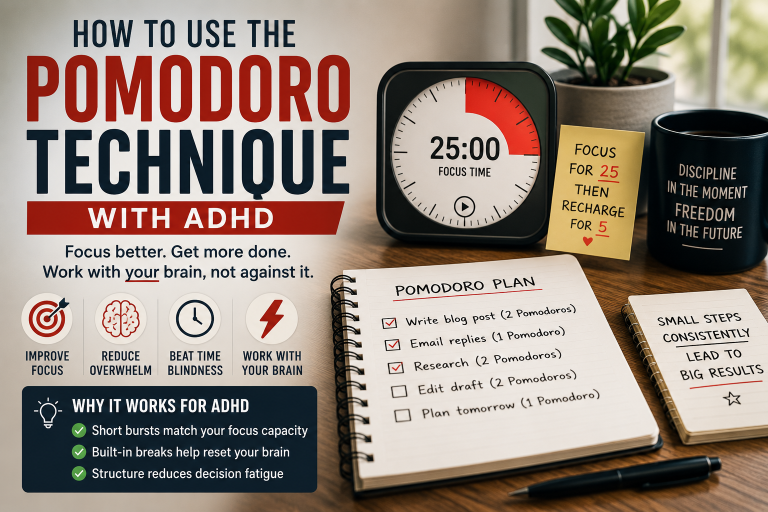
The Pomodoro Technique — 25 minutes of focused work followed by a 5-minute break, repeated in cycles — works exceptionally well for ADHD brains because it solves three of the biggest ADHD focus challenges simultaneously.
First it makes starting easier — committing to just 25 minutes of focused effort is far less overwhelming than committing to an entire day’s work. Second it makes time visible and urgent through the timer — directly countering ADHD time blindness. Third it builds in regular breaks that give the ADHD brain the neurochemical reset it needs to sustain focus across multiple sessions.
Use a dedicated Pomodoro timer — physical options like the Time Timer or digital options like Pomofocus.io — rather than your phone, which is both a distraction risk and a temptation to check notifications between sessions.
Action step: Use the Pomodoro Technique for your first task tomorrow. Set a 25-minute timer, commit to single-task focus for that interval, then take a genuine 5-minute break. Evaluate how your focus quality compares to unstructured work.
Step 8: Manage Your Sensory Environment Strategically
ADHD brains are often hypersensitive to sensory input — meaning that sounds, visual clutter, uncomfortable clothing, and other environmental sensory factors that neurotypical people filter out automatically can significantly impair ADHD focus. Managing your sensory environment strategically is a high-impact, low-effort focus intervention.
Noise-canceling headphones or white noise eliminate unpredictable auditory distractions — one of the most powerful ADHD focus tools available. Blue light glasses reduce visual fatigue during extended screen sessions. A clean, visually minimal workspace reduces the cognitive load of processing cluttered visual information. And for some ADHD adults, specific scents like rosemary or peppermint diffused during work sessions provide additional neurological focus support.
Action step: Identify the single sensory factor most disruptive to your focus — most commonly background noise. Address it with one tool this week — noise-canceling headphones, white noise, or simply moving to a quieter location.
Step 9: Practice Mindfulness and Meditation
The evidence for mindfulness-based interventions for ADHD has grown substantially in recent years. Multiple studies have found that regular mindfulness practice improves attention, reduces impulsivity, and supports emotional regulation in ADHD adults — all by training the brain’s ability to notice when attention has wandered and redirect it back to the intended focus.
You don’t need to meditate for an hour a day to see benefits. Research suggests that even 10 to 15 minutes of daily mindfulness practice produces measurable improvements in attentional control after eight weeks of consistent practice. Apps like Headspace, Calm, and Waking Up provide structured meditation programs that make starting accessible for ADHD adults who find unguided meditation impossibly difficult.
Action step: Download a meditation app and commit to 10 minutes of guided mindfulness practice every morning for two weeks before evaluating. Don’t judge the quality of individual sessions — consistency over time is what produces the neurological benefits.
Step 10: Create External Systems That Compensate for Internal Deficits
The final and perhaps most important strategy is this — stop trying to fix your ADHD brain from the inside and start building external systems that compensate for the internal deficits from the outside.
ADHD is a disorder of executive function — your brain’s internal management system. The strategies that work best for ADHD adults are not the ones that try to strengthen weak executive function through willpower but the ones that replace internal management with external structures.
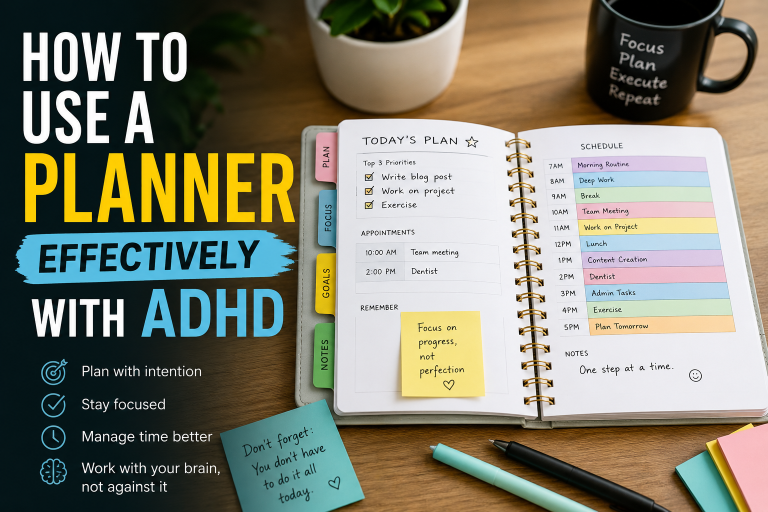
This means a planner that tells you what to do instead of relying on your working memory. A timer that tells you when time has passed instead of relying on your internal time sense. A distraction blocker that prevents impulsive browsing instead of relying on impulse control. A body doubling partner that provides external accountability instead of relying on internal motivation.
Build the external scaffolding that your ADHD brain needs. Stop blaming yourself for not having the internal capacity that ADHD takes away. And watch your focus transform as your environment starts working with your brain instead of demanding things from it that it was never wired to provide.
Common Mistakes to Avoid
Trying everything at once. Adding ten new strategies simultaneously is an ADHD trap — it creates overwhelm, makes it impossible to know what’s working, and almost always leads to complete system collapse within a week. Pick one strategy, implement it for two weeks, then add the next.
Expecting immediate results. Most non-medication focus strategies require weeks of consistent practice before their full benefits are realized. Evaluate after two to four weeks of daily implementation, not after two days.
Treating bad days as proof the strategy doesn’t work. ADHD means good days and bad days. One bad focus day after starting a new strategy doesn’t mean the strategy has failed. Look for trends over weeks not individual daily performance.
Neglecting sleep and exercise. These two interventions have the strongest evidence base of any non-medication ADHD focus strategies. If you’re trying sophisticated focus techniques while neglecting sleep and exercise, you’re optimizing the margins while ignoring the fundamentals.
Comparing your focus to neurotypical standards. Your ADHD brain will never focus exactly like a neurotypical brain — and that’s okay. The goal isn’t to eliminate ADHD. It’s to build systems and strategies that allow your unique brain to perform at its genuine best.
Frequently Asked Questions
Can ADHD be managed without medication? Many ADHD adults successfully manage their symptoms with non-medication strategies including exercise, sleep optimization, environmental design, therapy, and structured productivity systems. However the effectiveness of non-medication approaches varies significantly by individual and symptom severity. For many ADHD adults, combining medication with lifestyle strategies produces the best outcomes.
What is the most effective non-medication strategy for ADHD focus? Exercise has the strongest evidence base as a single non-medication intervention for ADHD focus — producing immediate improvements in attention and working memory that last for hours after a session. Environmental design and external structure systems are close seconds in terms of practical daily impact.
How long does it take to see improvement in ADHD focus without medication? Most lifestyle and behavioral strategies require two to eight weeks of consistent implementation before significant improvements are noticed. Sleep optimization often produces noticeable benefits within one to two weeks. Exercise benefits are more immediate — felt within hours of a single session.
Is caffeine effective for ADHD focus without medication? Many ADHD adults self-medicate with caffeine — and there is some evidence that low to moderate caffeine consumption can modestly improve focus in ADHD. However the effects are significantly weaker and shorter-lived than prescription medication and caffeine’s anxiety-inducing effects can worsen some ADHD symptoms. Pairing caffeine with L-theanine reduces the anxiety side effects while maintaining the alertness benefit.
Can therapy help with ADHD focus without medication? Yes — Cognitive Behavioral Therapy adapted for ADHD has strong evidence for improving executive function, emotional regulation, and coping strategies for ADHD adults. ADHD coaching is another effective option that focuses specifically on building the practical systems and accountability structures that support daily functioning.
Final Thoughts: Work With Your Brain, Not Against It
Improving ADHD focus without medication is not about trying harder. It’s about trying smarter.
Your ADHD brain has real neurological differences that create real focus challenges. But those same differences also give you creativity, passion, hyperfocus capacity, and a unique way of seeing the world that is genuinely valuable. The goal is not to become neurotypical. The goal is to build a life and a work environment that allows your unique brain to show up, perform, and thrive on its own terms.
Start with exercise and sleep. Build your external systems — planner, timer, distraction blocker, body doubling. Manage your sensory environment. And be patient with yourself as the strategies compound and the results accumulate.
You don’t need to be fixed. You need the right environment, the right tools, and the right systems. And with those in place, your ADHD brain is capable of remarkable things.
Ready to take control of your ADHD focus? Pick one strategy from this guide and implement it starting tomorrow. One step at a time, your focus will improve.