How to Use the Pomodoro Technique with ADHD
If you want to learn how to use the Pomodoro Technique with ADHD, you are about to discover one of the simplest…
If you want to learn how to use the Pomodoro Technique with ADHD, you are about to discover one of the simplest and most effective focus tools available for your brain.
Why the Pomodoro Technique Was Made for ADHD Brains
The Pomodoro Technique wasn’t specifically designed for ADHD.
But it might as well have been.
Francesco Cirillo created it in the late 1980s as a simple time management method. Work for 25 minutes, take a 5-minute break, repeat. Named after the tomato-shaped kitchen timer he used as a student, the method has since become one of the most widely practiced productivity techniques in the world.
According to ADDitude Magazine, one of the leading ADHD resources online, structured time based techniques like this are among the most commonly recommended non medication strategies for managing ADHD attention.
And in the ADHD community specifically, it has earned something close to cult status.
Here’s why. The three biggest focus challenges for ADHD adults are
Task initiation: The inability to start work even when you know you should.
Time blindness: The inability to perceive time passing accurately
Sustained attention: The inability to maintain focus on a non-stimulating task for extended periods.
The Pomodoro Technique addresses all three simultaneously.
It makes starting easier by reducing the commitment to just 25 minutes. It makes time visible and urgent through the timer. And it makes sustained attention manageable by breaking the workday into short, defined intervals with built-in breaks that work with ADHD neurochemistry rather than against it.
In this guide, we’ll walk you through exactly how to use the Pomodoro Technique with ADHD, including the specific adaptations that make it work better for ADHD brains than the standard approach.
Why This Matters Specifically for ADHD
The standard Pomodoro Technique is powerful for anyone. But ADHD brains need specific adaptations to get the maximum benefit from it. The default 25-minute interval may be too long or too short depending on your individual focus capacity. The standard break activities may not provide the neurochemical reset that ADHD brains need between sessions. And the rigid structure of the classic approach can feel punishing on bad ADHD days in a way that causes people to abandon it entirely.
The adapted approach in this guide preserves the core power of the Pomodoro method while building in the flexibility, self-compassion, and ADHD-specific strategies that make it sustainable for long-term use rather than another abandoned productivity system.
How to Use the Pomodoro Technique with ADHD — Step by Step
Step 1: Choose Your Timer Wisely
The timer is the engine of the Pomodoro Technique, and for ADHD brains, the type of timer you use matters more than most people realize.
Avoid using your phone as your Pomodoro timer. Your phone is the single greatest distraction risk in your environment. Every time you glance at it to check the timer, you’re also seeing notifications, messages, and the icons of every distracting app you own. The temptation to quickly check just one thing is almost always stronger than your intention to stay focused.
Instead, use a dedicated physical timer or a computer-based Pomodoro app.
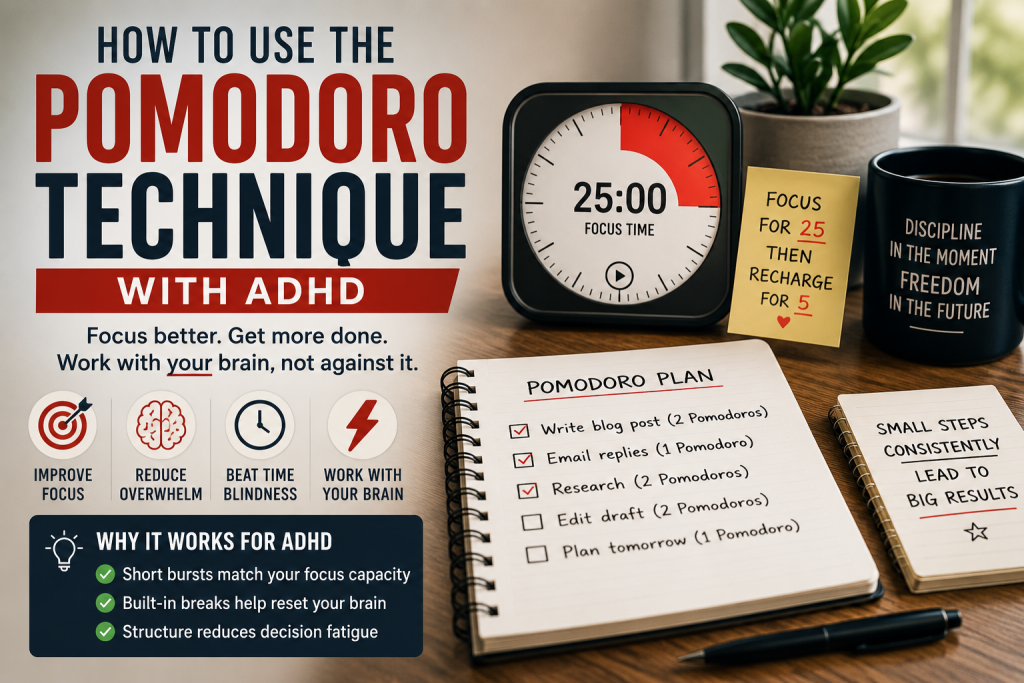
Physical options like the Time Timer with its visual shrinking red disk are particularly powerful for ADHD time blindness because they make time concrete and visible in a way that a digital countdown on a phone screen never does.
For a full breakdown of the best options available, check out our guide on the best Pomodoro timers for ADHD deep focus. Computer options like Pomofocus.io or Be Focused Pro keep your timer separate from your phone while keeping it accessible during computer-based work.
ADHD tip: Put your phone in a different room entirely before starting your first Pomodoro. The goal isn’t just to not look at it, it’s to remove the neurological temptation of knowing it’s within arm’s reach.
Step 2: Create Your Pomodoro Task List Before You Start
One of the biggest mistakes ADHD adults make with the Pomodoro Technique is starting a session without a clear, specific task in mind. Sitting down, starting the timer, and then trying to figure out what to work on during the session creates exactly the decision fatigue and task initiation difficulty that the Pomodoro is supposed to eliminate.
The night before or first thing in the morning, before you start working, create a simple list of the tasks you need to accomplish today and assign each one an estimated number of Pomodoros. A complex report might take four Pomodoros. Responding to emails might take one. A creative brainstorming session might take two.
This pre-planning means that when you sit down and start your timer, your brain already knows exactly what it’s supposed to be doing. No decisions, no paralysis, no wasted session time figuring out where to begin.
ADHD tip: Keep your Pomodoro task list to a maximum of five to seven items. A longer list creates overwhelm that can trigger task avoidance before you even start your first session.
Step 3: Start Your Pomodoro with a Two-Minute Warm-Up
ADHD task initiation difficulty is real, and one of the most common reasons people abandon the Pomodoro Technique is that starting a session still feels overwhelming even with a timer and a task list.
A simple solution is to begin each Pomodoro with a two-minute warm-up that eases your brain into the task before the main focus period begins. For a writing task this might mean re-reading the last paragraph you wrote. For a coding task it might mean reviewing the section you were working on yesterday. For an email task it might mean opening your inbox and scanning subject lines.
The warm-up lowers the barrier to entry by reducing the cognitive jump from rest state to full focus. By the time your two-minute warm-up is done, your brain is already engaged with the task and the transition into full focused work feels natural rather than forced.
ADHD tip: Count the two-minute warm-up as part of your 25-minute Pomodoro, not as time before it. The goal is momentum, not perfection.
Step 4: Work on One Task Only. Use a Capture List for Intrusive Thoughts
During a Pomodoro, your brain will generate intrusive thoughts. A task you forgot. An email you need to send. A random idea that feels urgent. An interesting question you want to Google. This is normal — and for ADHD brains it happens more frequently and feels more compelling than for neurotypical ones.
The standard advice is to simply ignore these thoughts and stay focused. For ADHD brains, this is easier said than done — an ignored intrusive thought often gets louder and more insistent until it becomes impossible to focus around.
The solution is a capture list — a notepad or sticky note kept next to your keyboard during Pomodoro sessions. When an intrusive thought appears, you write it down on the capture list in five seconds and immediately return to your task. The act of writing it down tells your brain that the thought has been captured and doesn’t need to compete for attention anymore — freeing you to return to focus without the cognitive struggle of trying to suppress it.
ADHD tip: Review your capture list during break times — not during sessions. Many of the items will feel less urgent after a break and you can decide then what actually needs to be acted on.
Step 5: Adapt Your Interval Length to Your Actual Focus Capacity
The standard Pomodoro is 25 minutes. For many ADHD adults this is a perfectly effective interval. But for others, particularly those just starting with the technique or on high-symptom days — 25 minutes feels impossibly long and becomes a source of shame rather than support when they inevitably lose focus before the timer ends.
The most important adaptation for ADHD is permission to customize your interval length. Start with whatever interval you can actually complete successfully, even if that’s just 10 or 15 minutes. A completed 15-minute Pomodoro is infinitely more valuable than a failed 25-minute one.
As your focus capacity builds through consistent practice, gradually increase your interval length. Many ADHD adults find they naturally settle at a personal Pomodoro interval of 15 to 45 minutes depending on the task type, their energy level, and the day’s symptoms.
ADHD tip: Keep a simple log of how many Pomodoros you complete each day and at what interval length. Over weeks this data will show you your personal focus capacity patterns and help you plan your workdays more realistically.
Step 6: Take Your Breaks Seriously — Move Your Body
The break is not a reward for surviving the Pomodoro. It is a neurochemical necessity that makes the next Pomodoro possible.
ADHD brains burn through cognitive resources faster than neurotypical ones. The prefrontal cortex — the brain region most affected by ADHD fatigues relatively quickly under sustained cognitive demand. A genuine break that allows this region to recover is what makes the next focus interval productive rather than a diminishing-returns struggle.
The most effective break activities for ADHD adults involve physical movement, such as standing up, stretching, walking to another room, doing a few jumping jacks, and getting a glass of water. Physical movement during breaks increases dopamine and norepinephrine levels, giving your ADHD brain a natural neurochemical refresh before the next session.
The worst break activity for ADHD adults is checking social media or news. The variable reward patterns of social media trigger dopamine release that makes returning to focused work significantly harder. If you open Instagram during a five-minute break, your Pomodoro session is likely over.
ADHD tip: Plan your break activity before starting the Pomodoro — “When this session ends I will stand up and walk to the kitchen for water.” Pre-deciding the break activity removes the decision that could lead to defaulting to phone checking.
Step 7: Handle Interruptions Without Abandoning the Session
Interruptions are inevitable, particularly for ADHD adults who work from home, in open offices, or with family members around. When an interruption happens during a Pomodoro, many ADHD adults either break their session to handle it or feel so derailed by the interruption that they abandon the session entirely.
The standard Pomodoro guidance is to use the “inform, negotiate, schedule, call back” approach: inform the person that you’re in the middle of something, negotiate a brief delay, schedule a specific time to address their need, and call back as promised. This works well for non-urgent interruptions.
For urgent interruptions that require you to stop your Pomodoro, simply mark the session as interrupted, handle the urgent matter, and start a fresh Pomodoro when you return. An interrupted session is not a failed session; it’s information about your work environment that can help you identify when and where to schedule future Pomodoros for minimum interruption risk.
ADHD tip: Block your highest-priority Pomodoros during the times of day when interruptions are least likely — early morning before others are awake, during established quiet hours, or with a visible “do not disturb” signal that colleagues and family learn to respect.
Step 8: Use the Long Break Strategically
After every four Pomodoros, the standard technique calls for a longer break of 15 to 30 minutes. For ADHD adults, this longer break is an opportunity to do something that genuinely refreshes the nervous system rather than just filling time.
The best long break activities for ADHD include a short walk outside in natural environments have a demonstrated restorative effect on attention that indoor environments don’t provide, a brief mindfulness practice or meditation, a light snack that supports neurotransmitter production, like nuts, fruit, or protein, or a brief physical exercise like a set of bodyweight movements.
Avoid using your long break for tasks that require significant cognitive effort, such as answering complex emails, making difficult phone calls, or working on secondary projects. The long break should genuinely restore your cognitive resources, not deplete them in a different direction.
ADHD tip: If you find 15 to 30 minutes feels too long and you lose momentum during the long break, try 10 to 12 minutes instead. The goal is genuine recovery, not a specific time duration.
Step 9: Track Your Pomodoros and Review Weekly
One of the most powerful but least practiced aspects of the Pomodoro Technique for ADHD adults is the tracking and review process. Keeping a simple daily record of how many Pomodoros you completed and what you worked on during each one generates valuable data about your focus patterns over time.
After two to three weeks of tracking, you’ll start to see patterns. Your most productive time of day, the tasks that consistently take more Pomodoros than you estimated, the days of the week when your focus is strongest, and the environmental factors that correlate with your best and worst focus sessions.
This data is gold for ADHD adults because it replaces the inaccurate, shame-filled narratives most of us carry about our productivity with objective evidence about how we actually work. It transforms Pomodoro tracking from a focus tool into a self-knowledge system.
ADHD tip: A simple tally mark system on a daily notepad is all you need to track Pomodoros effectively. Don’t overcomplicate the tracking — the point is patterns over time, not elaborate logging.
Step 10: Practice Self-Compassion on Bad Focus Days
The final and arguably most important step in using the Pomodoro Technique with ADHD is this — build self-compassion explicitly into your practice.
ADHD means that some days your focus will be excellent and some days it will be genuinely terrible regardless of how well you’ve slept, how well you’ve eaten, or how perfectly you’ve set up your environment. Bad focus days are not failures. They are a normal part of living with ADHD.
On bad days, reduce your Pomodoro interval to whatever length you can actually complete. Complete one Pomodoro and consider it a win. Be gentle with yourself about the gap between what you planned and what you accomplished.
The ADHD adults who build lasting Pomodoro habits are not the ones who perform perfectly every day. They’re the ones who show up imperfectly but consistently — who complete one 15-minute Pomodoro on a terrible day rather than zero because they couldn’t face a 25-minute one.
Progress over perfection, always.
Common Mistakes to Avoid
Using your phone as your timer. The notification risk alone makes this a focus-destroying choice. Use a dedicated physical or computer-based timer instead.
Skipping the break. The break is not optional — it’s the mechanism that makes the next session productive. Skipping it to power through leads to rapidly diminishing focus quality across sessions.
Starting without a clear task. Beginning a Pomodoro without knowing exactly what you’re working on during it creates decision fatigue that defeats the purpose of the technique.
Abandoning the system after one bad day. Bad focus days are inevitable with ADHD. They’re not proof that the technique doesn’t work — they’re proof that you have ADHD. Show up the next day and start again.
Comparing your Pomodoro count to others. Four quality Pomodoros on a challenging ADHD day is a genuine achievement. It doesn’t matter how many someone else completed. Your focus capacity is your own — measure your progress against your own baseline.
Frequently Asked Questions
Is the Pomodoro Technique good for ADHD adults? Yes — the Pomodoro Technique is one of the most widely recommended productivity methods for ADHD adults precisely because it directly addresses the core ADHD focus challenges of task initiation, time blindness, and sustained attention. The structured intervals, visible timer, and regular breaks align naturally with how ADHD brains work best.
What Pomodoro interval is best for ADHD? The optimal interval varies by individual. Start with 15 to 20 minutes if 25 minutes feels too long. Gradually increase toward 25 to 45 minutes as your focus capacity builds. The best interval is the longest one you can consistently complete without losing focus — not the standard 25 minutes if that doesn’t match your capacity.
What should I do during Pomodoro breaks with ADHD? The most effective break activities for ADHD adults involve physical movement — walking, stretching, or brief exercise. Avoid checking social media, news, or email during breaks as these make returning to focus significantly harder.
Can I use the Pomodoro Technique for creative work? Many ADHD writers, designers, and creators find the Pomodoro Technique particularly effective for creative work because the time constraints create urgency that enhances creative output. The fixed interval prevents both creative paralysis and endless unproductive tinkering.
What if I can’t focus even for 25 minutes? Reduce your interval. Start with 10 or 15 minutes and build up gradually. The goal is to find the interval length where you can consistently succeed, not to force yourself to match an arbitrary standard. Consistent 15-minute Pomodoros that actually happen are infinitely more valuable than 25-minute Pomodoros that you never start because they feel too long.
Final Thoughts: The Pomodoro Technique Gives Your ADHD Brain Permission to Be Finite
The hardest thing about work with ADHD is not the work itself, it’s the open-endedness of it. The sense that focus is required indefinitely, that you need to stay on task for an uncertain amount of time, that there’s no defined end point where you can legitimately stop and rest.
The Pomodoro Technique solves this. It gives your brain a defined beginning and a defined end. It says — 25 minutes, then you’re free. And that finitude, that clear boundary, is often all an ADHD brain needs to actually start.
Begin with your first Pomodoro today. Set your timer for whatever interval feels manageable. Pick one task. Start.
Twenty-five minutes from now you’ll have accomplished something real. And that momentum however small — is how every great productivity transformation begins.
Continue Your Growth
- Best Pomodoro Timers for ADHD Deep Focus
- How to Use Time Blocking if You Have ADHD
- How to Prioritize Tasks When You Have ADHD
- How to Build a Time Management System for ADHD
- Dopamine and Productivity: 5 Proven Strategies
Ready to use the Pomodoro Technique to transform your ADHD focus? Set your timer for 25 minutes right now and start with just one session. You might be surprised what’s possible in just 25 minutes.